



A major event can start changing a city’s job market long before most people notice it. Construction crews can be working on projects years ahead of the opening, businesses can begin preparing for more visitors, and suppliers can see new demand well before the first athlete arrives. By the time the event is underway, the workforce may look completely different again, with more people needed across hospitality, transport, logistics, venue operations and visitor services.
What happens afterwards is another part of the story. Some event-related work naturally comes to an end, while other businesses continue operating and infrastructure remains in use. In a city preparing for a major international event, employment can therefore build up, change direction and continue in different forms over several years.
That makes Brisbane Olympics jobs interesting to compare with employment around other major events. Brisbane 2032 is being developed alongside infrastructure projects, tourism activity, business opportunities and a longer-term legacy program, with Brisbane City Council’s current legacy planning extending through 2042.
Rather than simply asking how many jobs a major event creates, it is worth looking at how the type of work changes as the event gets closer — and what happens to that work once the crowds have gone home.
The First Jobs Can Appear Long Before the Event
The easiest part of a major event to see is the event itself. The harder part to see is everything that has to happen beforehand.
A new venue needs to be planned, designed and built. Existing facilities may need upgrades. Transport connections have to be considered. Businesses need to prepare for changing demand, while suppliers and contractors have to get ready for projects that can take years to complete.
This is why the employment story surrounding Brisbane 2032 is already much broader than the people who will eventually work at the Games. Queensland’s Brisbane 2032 program includes infrastructure, procurement, tourism, logistics, technology, hospitality and event services. The state also describes the Games as an opportunity to support jobs, skills development, investment and longer-term economic activity.
For someone working on a Brisbane 2032-related project, the connection to the Olympics might not always be obvious.
They could be an engineer working on infrastructure. They could be part of a construction team, a supplier, a technology company or a professional services firm. Their employer might be involved in a procurement contract without having anything to do with the day-to-day running of the Games.
That is an important distinction when talking about Brisbane 2032 jobs.
Not every job connected to the wider Brisbane 2032 economy will have “Olympic” in its job title.
Construction Is Only the Beginning
Construction is probably one of the easiest areas to associate with a major sporting event, but even this part of the story is more complicated than it first appears.
A large project can involve people at very different stages. There are planners and designers at the beginning, followed by engineers, tradespeople, project managers, contractors, suppliers and other specialists as the work progresses. Behind those workers are companies providing materials, equipment, transport, software, safety services and professional support.
The work can therefore spread well beyond the physical construction site.
Brisbane’s current planning places emphasis on infrastructure that can serve the city beyond the Games. Brisbane City Council describes new and upgraded facilities and infrastructure as part of the longer-term legacy, while Queensland’s 2032 plans also connect venue development with use beyond the event itself.
That changes the employment conversation.
A project is not necessarily being built simply so it can be used for a few weeks in 2032. Some infrastructure is intended to remain part of Brisbane’s everyday environment afterwards.
The people building it may eventually move on to other projects, but the facilities and infrastructure can continue creating work through maintenance, operations, transport, hospitality and other services.
Then the Focus Starts to Shift
As the event gets closer, the nature of the work can change.
The early question might be about getting a project finished. Later, the question becomes how a city, business or venue is going to handle the people who will actually arrive. This is where industries such as hospitality, tourism, transport and event services can become increasingly important.
A hotel preparing for a major increase in visitors may need additional staff. Restaurants may need to increase their capacity. Transport businesses may have to prepare for higher demand. Tourism operators may see opportunities to attract visitors who are coming to Brisbane for more than the sporting events themselves.
The work is different from construction, but it is connected to the same wider cycle.
This is one of the reasons it can be misleading to think of Brisbane Olympics jobs as one large category. A construction worker and a hotel employee may both benefit from activity surrounding the Games, but they may experience that activity at completely different points.
Other Major Events Can Have a More Concentrated Workforce
This is where the comparison with other major events becomes useful.
Some major events create a particularly intense period of activity as the deadline approaches. Construction schedules become tighter, venues have to be prepared, suppliers have to deliver equipment and businesses need to be ready for a sudden increase in visitors.
The workforce can grow quickly around this period.
A contractor may need additional workers to complete a project. An event company may bring in staff for installation and operations. Hotels and restaurants may increase their staffing levels. Transport and security services can also need more people to cope with the event.
That can create a very visible employment peak.
But it would be too broad to say that every major event follows exactly the same pattern. Some events rely heavily on existing infrastructure. Others involve substantial construction programs. Some create lasting facilities and tourism activity, while others have a much more limited physical footprint.
The employment effect depends on the event, the host city, the investment involved and the industries supporting it. So the useful comparison is not “Brisbane has permanent jobs and other events have temporary jobs.”
It is more about the shape of the employment cycle.
Brisbane 2032 Has a Longer Runway
Brisbane’s official planning gives the city a longer period around which this employment activity can develop.
Brisbane City Council describes its Games legacy journey as running from now through 2042, covering the years leading up to the Games as well as the decade afterwards. Its legacy plan includes long-term outcomes relating to the economy, transport, infrastructure, community and lifestyle.
Queensland similarly describes Brisbane 2032 as more than a sporting event, linking it with sustainable growth, jobs, infrastructure, tourism and skills development beyond the closing ceremony.
That does not mean people will stay in the same Brisbane 2032 jobs for that entire period. A construction project finishes. A contract expires. A business changes its staffing requirements. Workers move between employers and industries.
What changes is the wider environment in which those jobs exist. One industry may be particularly busy at one point, while another becomes more active later.
That makes the employment story feel less like one enormous recruitment campaign and more like a series of overlapping stages.
Tourism Has Its Own Timeline
Tourism is an especially interesting part of the comparison because it does not have a clear end date.
An event has a closing ceremony. Visitors eventually fly home. The temporary workforce needed for certain event operations may no longer be required. But the hotels, restaurants, attractions and tourism businesses remain.
Brisbane City Council identifies increased demand for tourism, trade and investment among the economic opportunities associated with Brisbane 2032. Queensland also identifies tourism and international exposure as part of the wider Games legacy.
That does not guarantee that every tourism business will grow or that every tourism job will continue after 2032. The industry will still depend on visitor numbers, business conditions and many factors unrelated to the Olympics. The point is that tourism can create a longer-running form of employment than a role that exists solely to deliver an event.
A person working in hospitality in 2032 may be serving Olympic visitors, but the same hotel, restaurant or attraction can continue operating after the Games.
What Happens When the Crowds Leave?
This is probably the part of major-event employment that gets the least attention.
During the event, there is an obvious reason for the extra workforce. There are visitors to accommodate, venues to operate and services to provide.
Afterwards, the situation changes.
Some work will naturally disappear because its purpose has been completed. A temporary event contract might finish. A construction project might reach its final stage. A business that hired extra staff for a short period may return to normal staffing levels.
But not everything disappears. Brisbane’s legacy planning specifically considers what remains after the Games, including infrastructure, connectivity, community and economic outcomes.
A facility still needs to operate. Transport infrastructure still needs to be maintained. Businesses continue serving customers. Tourism does not suddenly stop. This is where the idea of a long-term employment story becomes more useful than simply counting jobs created for the event.
A Brisbane 2032 Job Does Not Have to Look Like an Olympic Job
There is another side to this that is easy to overlook.
Imagine someone working for a company that supplies equipment to a project connected with Brisbane 2032. They may never enter an Olympic venue and may never work for the Games organising committee. Their employer might simply be part of the supply chain.
The same thing can happen in tourism. A hotel receptionist may spend part of their working week serving visitors who have travelled to Brisbane because of the Games. A chef may prepare meals for tourists. A warehouse worker may help supply businesses dealing with increased demand.
None of these people necessarily have what most people would call an “Olympic job”. Yet their work can still be connected to the broader economic activity around the event.
This is why searching only for jobs with “Olympics” or “2032” in the title can give a very narrow impression of the employment opportunities surrounding a major event.
The Same City Can Need Different Workers at Different Times
Perhaps the most interesting part of this comparison is that the workforce itself can change as the event moves forward.
Early in the cycle, infrastructure and construction can be important. Alongside that, there can be demand for engineering, planning, procurement, project management and professional services.
As businesses prepare for visitors, tourism, hospitality, logistics and technology can become more prominent.
Closer to the Games, the focus shifts towards event delivery. Venues need to operate, visitors need assistance, equipment needs to move and transport systems need to function.
Afterwards, the nature of the work changes again. Some event-specific roles finish, while facilities, tourism businesses, infrastructure and other services continue.
It is therefore possible to have several different employment markets surrounding the same event. They simply happen at different times.
This Is Where Brisbane and Other Events Can Diverge
The comparison becomes more useful when we stop trying to put every major event into the same box.
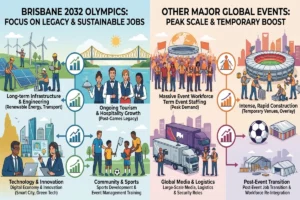
A large international event can generate an enormous workforce in a relatively short period. It can create intense construction activity, followed by a rush of event operations and visitor-related employment.
Another event might involve years of infrastructure development and leave facilities that become part of the host city’s everyday life.
Brisbane 2032 is being planned with a strong emphasis on the period before and after the Games. Official plans connect the event with long-term infrastructure, tourism, skills, economic activity and legacy outcomes.
That does not make Brisbane completely unique. Other host cities have also planned for long-term benefits from major sporting events.
What is distinctive for this discussion is the length of the runway being planned around Brisbane 2032 and the effort to connect the Games with wider infrastructure and legacy objectives.
The Difference Is Not Simply Temporary vs Permanent
This is worth spelling out because it is easy for articles about major-event employment to oversimplify the issue. Calling one event’s workforce “temporary” and another’s “long-term” can hide what is actually happening.
A person can have a temporary construction contract on a long-term infrastructure project. A tourism job can continue for years without being an Olympic position.
An event operations role might last only a few months but provide work at a time when demand is unusually high. A permanent business can hire temporary staff because of an event. Employment does not fit neatly into two boxes.
The more useful question is:
What kind of work is being created, when is it needed, and what remains once the event has finished?
That gives us a much clearer way to understand Brisbane Olympics jobs vs other major events.
Brisbane’s Employment Story Is Bigger Than the Games
The official Brisbane 2032 plans make it clear that the Games are being considered alongside wider infrastructure and economic development.
Brisbane City Council describes the Games as an opportunity to create new and upgraded facilities, improve connections and support tourism, trade and investment. Queensland’s Games legacy material similarly describes longer-term benefits for communities, the economy and infrastructure.
For workers, that means the employment story can extend beyond the organisations directly responsible for staging the Games.
There can be opportunities through businesses supplying projects, companies responding to tourism demand, contractors working on infrastructure and employers providing services to a growing city.
The connection may be obvious in some cases and barely visible in others. That is normal when a major event becomes part of a much larger economic program.
What Could Remain After 2032?
No one can know exactly what Brisbane’s employment market will look like after the Games.
Individual businesses will make their own decisions. Projects will be completed. Tourism patterns will change. New industries may emerge while others evolve.
What can be said now is that Brisbane’s official legacy planning is deliberately looking beyond the event itself.
Council’s current legacy plan covers the period through 2042, while Queensland’s wider Games strategy describes benefits intended to extend beyond the competition period.
That means the conversation about Brisbane 2032 jobs does not necessarily end when the final competition does.
The people who build infrastructure may move on. The workers hired specifically for the event may finish their contracts. But the buildings, transport connections, businesses, tourism activity and other investments can continue to shape the city.
That is where a long-term employment story can develop.
A Different Way to Look at Major Event Jobs
Instead of thinking about a major event as one large hiring exercise, it may be more realistic to picture it as a moving target. At first, the focus is on building and planning. Then businesses begin preparing.
As the event gets closer, visitor-facing industries become increasingly important. During the event, operational work reaches its most visible point.
Afterwards, some jobs finish while other forms of work continue around the infrastructure and economy that remain. Different major events can move through these stages at different speeds and with different levels of investment.
Brisbane 2032 is particularly interesting because the official plans connect the Games with a much broader program of infrastructure, tourism, skills and legacy development.
Final Thoughts
The easiest way to think about Brisbane Olympics jobs is not as one enormous list of vacancies waiting to appear in 2032. The employment story is more gradual than that.
A construction worker might be involved years before the Games. A supplier might benefit from a project without ever working at a venue. A hotel may hire as visitor demand grows. An event worker may be needed when the Games are underway. Afterwards, some of those positions will end while other businesses and infrastructure continue operating.
Other major events can create similar opportunities, but the timing and intensity can be very different depending on the host city, infrastructure program and event itself.
For Brisbane, the official approach puts considerable emphasis on what happens beyond the Games. The city’s current legacy planning runs through 2042, while Queensland’s strategy links Brisbane 2032 with longer-term infrastructure, tourism, jobs and skills.
So perhaps the most useful way to compare Brisbane with other major events is not to ask which one creates more jobs. It is to ask what kind of work appears along the way, how long that work lasts, and what the city is left with when the crowds have gone home.
That is where the Brisbane 2032 employment story becomes much bigger than the Games themselves.