A team training matrix should show which work needs particular capability, what evidence is available for each person and where training, supervision or authorisation is still required. It is most useful when managers can trace a status back to a real record.
Do not use a coloured cell as proof that someone may perform a task. Course attendance, demonstrated competence, a current licence and workplace authorisation can be different requirements.

Begin with defined tasks
List the tasks relevant to the team rather than every course someone has attended. Describe each task precisely enough to identify its requirements and any limits on responsibility.
For a fictional office, “prepare a draft monthly stock report” and “approve a stock write-off” should be separate entries. Preparing information does not automatically grant authority to approve the decision that follows.
Identify any regulated work or task requiring specialist review. The matrix should point to the correct requirements rather than inventing a local substitute for them.
Choose status labels that mean something
An original set of planning labels could include:
- Not yet reviewed: evidence or requirements still need checking.
- Learning planned: an agreed activity has not been completed.
- Supervised practice: the person is learning under the specified arrangement.
- Evidence reviewed: the relevant assessment or demonstration has been checked.
- Authorised within stated limits: a separate workplace decision has been recorded.
- Review required: a change or currency issue needs attention.
Adapt these to the organisation’s actual process. Do not automatically progress a person through every label or assume that one manager’s observation replaces a required formal assessment.
Attach evidence and ownership
For each relevant entry, record the task, person, requirement, evidence location, date checked, assessor or reviewer and next action. Include licence or qualification details only where necessary and use approved restricted records for personal information.
WorkSafe Queensland’s training and supervision guidance emphasises training suited to the work and checking understanding. A list of completed courses alone does not show how those needs are met.
The matrix can reference an individual credential register, but it serves a different question: what capability and coverage exist across the team for a defined set of tasks?
A fictional coverage gap
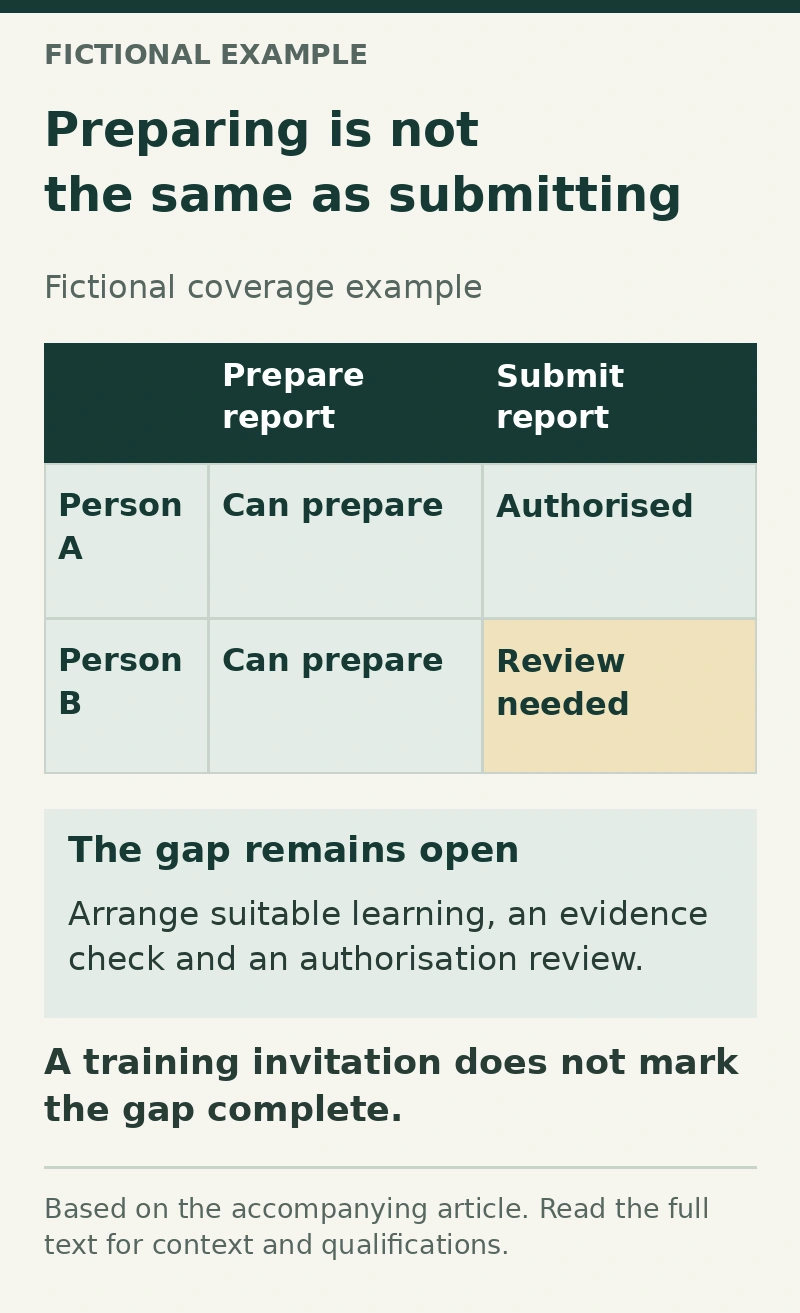
In this invented example, two office employees can prepare the stock report, but only one has been authorised to submit it through the organisation’s approved process. The matrix identifies that submission coverage needs a decision.
The manager arranges suitable learning, an evidence check and an authorisation review for a backup person. The gap is not marked complete when a training invitation is sent.
The manager also checks that the proposed arrangement leaves enough time and supervision for the learning activity without disrupting essential work.
Review after changes
Update the matrix when tasks, systems, responsibilities or relevant requirements change. Check unresolved entries before relying on the matrix for rostering or coverage decisions.
Use a review date where it has a defined purpose, distinguishing it from a credential’s actual expiry date. A useful matrix ends with a manageable set of owned actions: verify evidence, provide practice, confirm a requirement or obtain the appropriate authorisation decision. Keep the record understandable enough that another manager can explain the basis of each status.
For entries involving regulated credentials, use the Queensland work licences and tickets guide to frame the separate issuer and requirement checks.