

Answer a salary-expectations question by clarifying the role and employment basis, then explaining a reasonable expectation using current evidence. Before naming a figure, check whether the conversation concerns base salary, a package including superannuation or an hourly rate with separate conditions.
This is preparation for a conversation, not a salary benchmark or a calculation of minimum entitlements. Use our salary comparison guide for the broader factors that affect an offer.

Research the work you are discussing
Compare roles with similar duties, responsibility, location, hours and employment type. A management title, contractor day rate and casual hourly rate cannot be treated as equivalent evidence simply because they appear in the same search result.
Keep the source and date beside any figure you use privately. Distinguish advertised ranges from confirmed offers and broad survey averages. A future event or a claimed skills shortage does not establish what one employer will pay you.
For minimum conditions, use the Fair Work Ombudsman award resources where the national system applies. Market expectations and legal minimums answer different questions; negotiating a salary does not remove minimum entitlements.
Three fictional answer options
These are original practice responses. They contain no market-pay recommendation or guaranteed negotiation outcome.
When you do not know the employer’s range: “I would like to understand the level of responsibility and the full arrangement before giving a firm expectation. Could you share the approved range and confirm whether it is base salary or a total package?”
This keeps the discussion open without pretending you have enough information. If the recruiter needs a number to progress, decide what you can honestly support rather than repeating an unresearched figure from an unrelated role.
When you have researched a range: “Based on comparable roles with these duties and the experience I would bring, my expectation is $65,000–$70,000 a year in base salary, excluding superannuation. I would like to check the ordinary hours and package components before confirming.” This range is entirely hypothetical: it is not a Brisbane market benchmark, a minimum entitlement or a recommendation for your role.
In a real conversation, replace that invented range with your actual researched expectation if requested and useful. Your personal minimum and the employer’s budget may still differ.
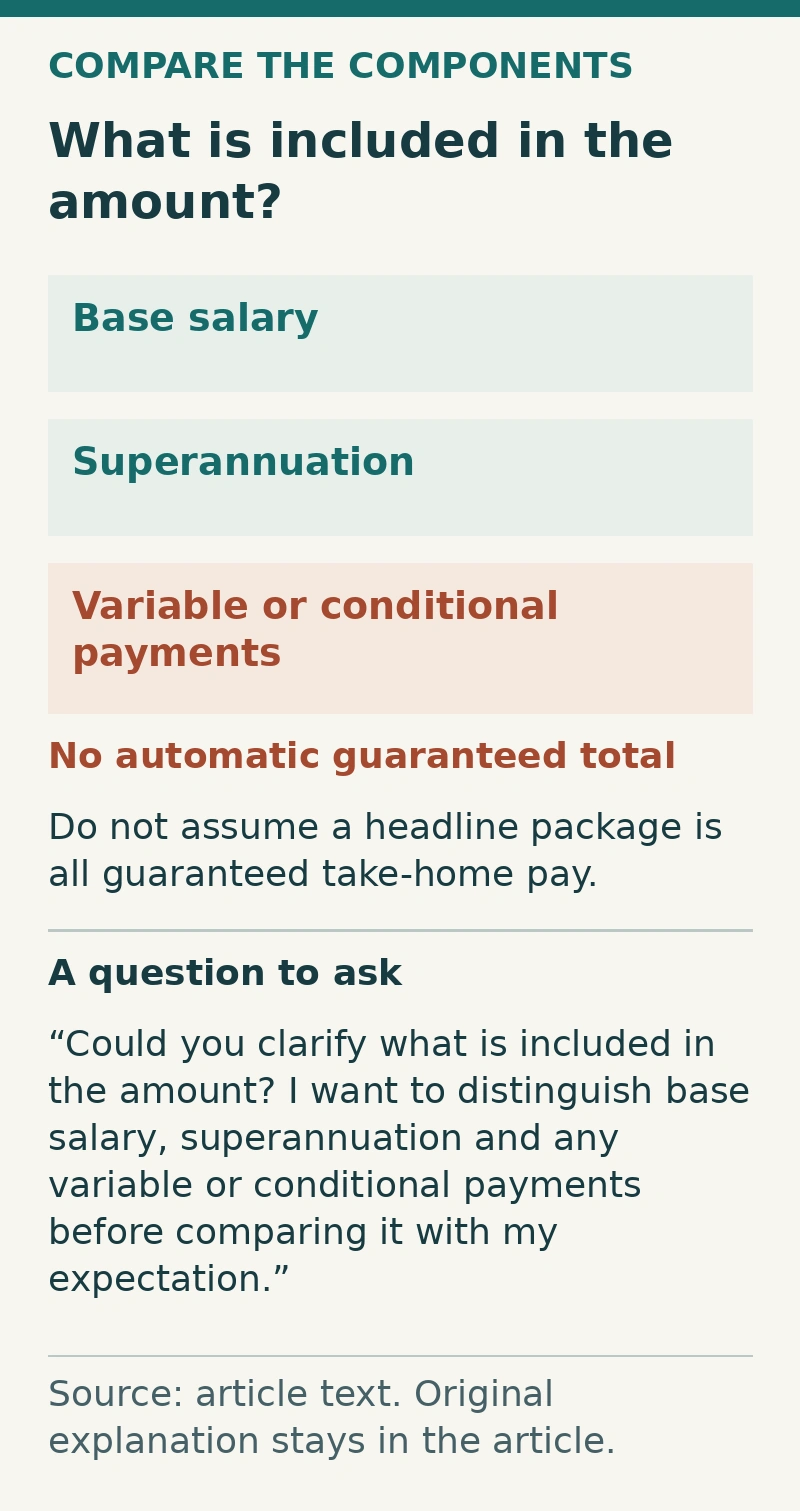
When the package is unclear: “Could you clarify what is included in the amount? I want to distinguish base salary, superannuation and any variable or conditional payments before comparing it with my expectation.”
Ask how overtime, allowances or bonuses are treated if relevant. Do not assume that a headline package is all guaranteed take-home pay.
Prepare your boundaries before the call
Write down what you need to know before deciding: duties, location, hours, employment type and financial commitments. Identify which elements are essential and which are preferences. Keep your private budget separate from the evidence you use to explain the value of your experience.
Avoid inventing another offer or inflating current pay. An evidence-based discussion is more useful than a claim you may later be asked to explain. You can also say that an amount is outside your workable range without presenting the employer as wrong about its budget.
Confirm what happens next
If the role progresses, ask for the actual terms in writing. An early screening conversation is not a final offer, and a recruiter’s indicative range is not necessarily an approved commitment.
Use our interview guide to prepare the rest of the discussion. Once a real offer exists, negotiation becomes a separate task involving specific requests and confirmation of any changes.