




Read a payslip by checking the pay period, hours and rates first, then the amounts added and deducted, and finally the net payment. Compare it with your own work records and the applicable employment conditions rather than assuming the bank deposit tells the whole story.
For employees covered by the national system, the Fair Work Ombudsman payslip guide sets out required information and says payslips must be provided within one working day of payday. This article explains a checking method; it does not calculate your individual entitlement or tax.

Identify the period and the parties
Check that the employer and employee details are correct and that the pay period matches the work you are reviewing. A payment date can be different from the final day of the period. Keep that distinction clear when comparing shifts with a bank transaction.
If you work for more than one employer, keep separate records. A recruitment agency, workplace venue and legal employer may have different names. Ask payroll if you do not recognise the entity on the payslip rather than combining unrelated payments.
Check hours, rates and separate items
For hourly work, compare the recorded hours with your own timesheet or roster and any approved changes. Look for separate ordinary hours, overtime, penalties, allowances or loading information where relevant. A payslip entry does not establish that the underlying rate or classification is correct.
If a payment seems to include several components in one rate, ask for an explanation of the breakdown and how it relates to your conditions. Do not assume the same treatment applies to every shift, day or employee.
A fictional arithmetic example
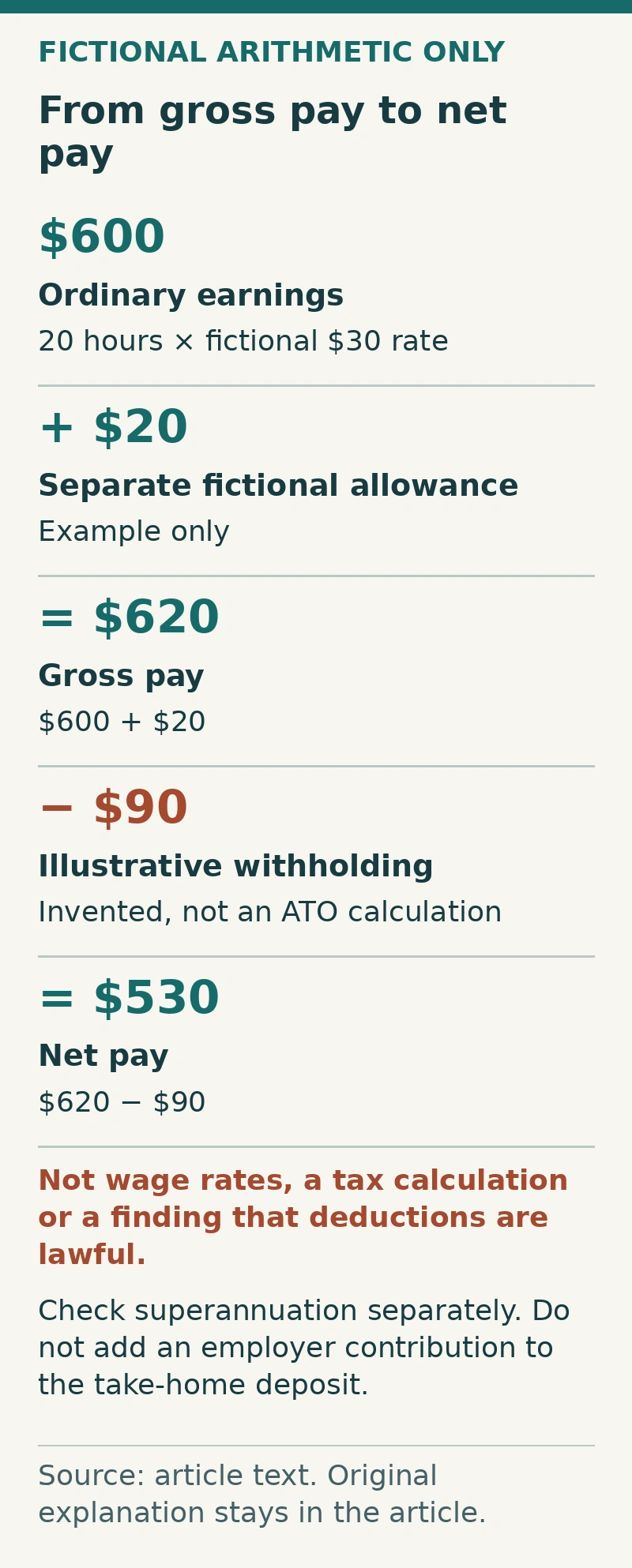
The numbers below are invented to explain a payslip. They are not a minimum wage, award rate, tax calculation or statement of lawful deductions.
| Illustrative item | Calculation | Amount |
|---|---|---|
| Ordinary earnings | 20 hours × fictional $30 rate | $600 |
| Separate fictional allowance | Example only | $20 |
| Gross pay | $600 + $20 | $620 |
| Illustrative withholding | Invented, not an ATO calculation | $90 |
| Net pay | $620 − $90 | $530 |
In this example, $530 is the amount expected to reach the bank account. It is not the gross earnings figure. A different real employee could have different rates, allowances, withholding and lawful deductions.
Superannuation information needs a separate check. A payslip may show contributions made or intended; the entry alone does not prove that a fund has received the money. Do not add an employer contribution to your take-home deposit when reconciling the payment.
Read deductions and balances carefully
Ask what each unfamiliar deduction represents. Arithmetic agreement does not by itself make a deduction lawful. Keep the explanation and any relevant authorisation, and seek official help if the issue is unresolved.
The FWO guidance also distinguishes required information from best practice, including leave balances. An absent leave balance on the payslip does not automatically mean no leave exists. Ask the employer for the relevant balance and records rather than inferring it from a blank field.
Avoid forwarding an unredacted payslip to a public group. It may expose names, account or fund details and other personal information. A short query can identify the pay period and disputed entry without publishing the entire document.
Raise a specific payroll question
For example: “My record shows the approved extra shift on Tuesday, but I cannot identify it in this period’s hours. Could you show how it has been included?” Attach only the relevant record through a verified payroll channel.
Save the original payslip, your query and the response. If a correction is made, keep the corrected version as well. Use the FWO guidance for national-system issues, or the relevant state authority where a different system applies.
For offer comparisons before starting work, use our salary guide. A payslip check is the later task of reconciling what was actually recorded and paid.