Plan parental leave as two related tasks: arranging time away from employment and checking any payment available during that time. An employer’s leave approval, a workplace paid-leave benefit and Australian Government Parental Leave Pay are separate processes with different rules.
Do not assume that approval of one automatically completes the others. Make a record of the organisation responsible for each decision, the documents it needs and the dates you must confirm.

Separate the three possible arrangements
First, check the employment entitlement to time away. Fair Work’s applying for parental leave guidance explains eligibility, including the service requirement and additional conditions for casual employees. It describes ten weeks’ written notice and confirmation steps, with exceptions where the required notice is not possible. Check the actual dates and rules for continuous or flexible leave.
Second, check any employer-funded payment under your award, agreement, contract or policy. Ask about its conditions and how it interacts with other payments. A workplace benefit should be read from the actual document rather than inferred from a colleague’s arrangement.
Third, check Services Australia’s government payment rules. Fair Work’s payment during parental leave guidance explains that eligible employees may receive government payment, employer-funded payment or both, depending on the applicable arrangements.
Use the child’s relevant date for government payment
Services Australia’s current payment information, checked on 5 November 2026, identifies up to 130 days to share as a family for a child born or adopted from 1 July 2026. That is 26 weeks on a five-day basis; it is not a promise that each parent separately receives 26 weeks.
Eligibility and sharing rules still matter. Check the current work, income, residence and other requirements directly with Services Australia. Payment duration should not be treated as the length of an approved absence from your particular job.
A fictional planning map
The following original example names tasks rather than deciding anyone’s eligibility.
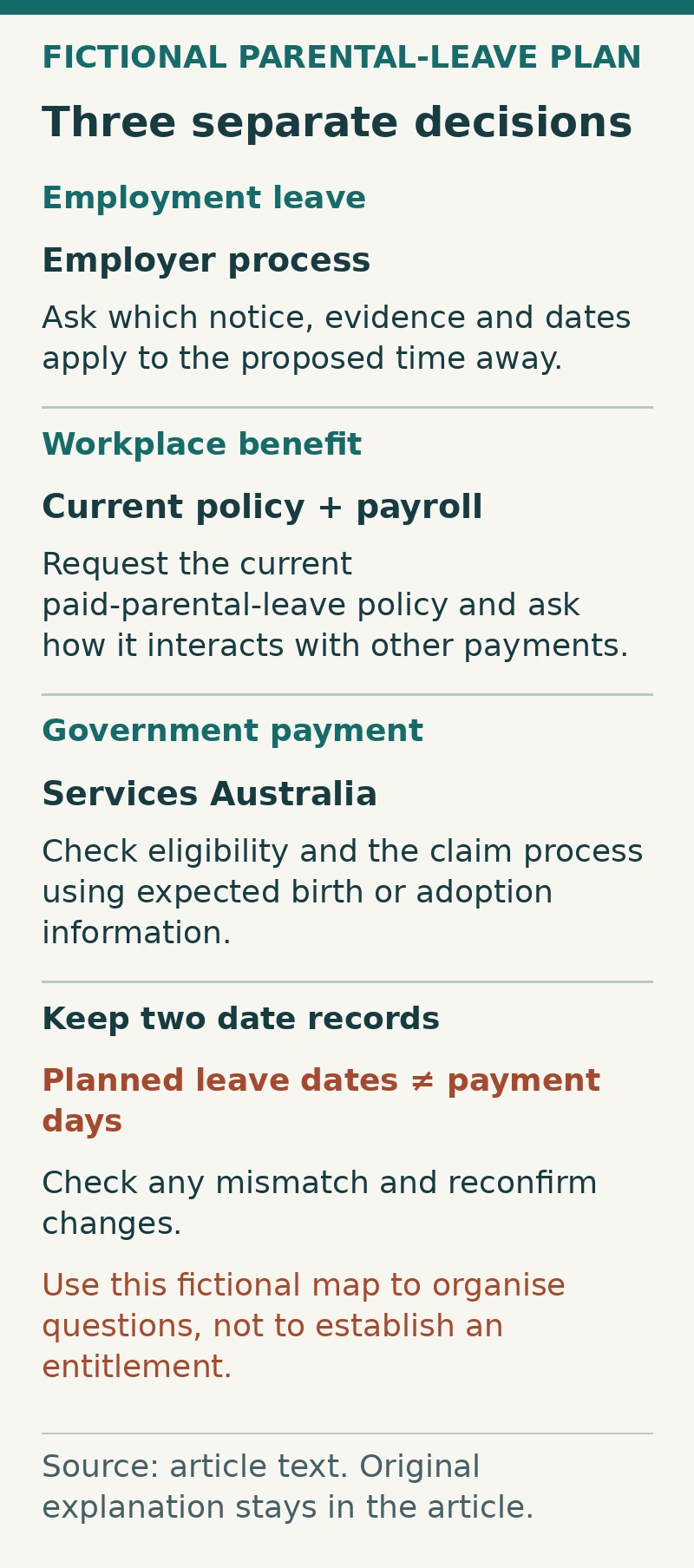
- Employment leave: Alex asks the employer which notice, evidence and dates apply to the proposed time away.
- Workplace benefit: Alex requests the current paid-parental-leave policy and asks payroll to explain its interaction with other payments.
- Government payment: Alex checks the Services Australia eligibility and claim process using the expected birth or adoption information.
- Coordination: Alex records planned leave dates separately from payment days and checks any mismatch.
- Changes: Alex notes whom to contact if the timing changes and what must be reconfirmed.
- Return: Alex schedules a later conversation about the applicable return-to-work process.
All details are fictional. Use this map to organise questions, not to establish an entitlement from a made-up scenario.
Make a practical records folder
Keep the relevant employer documents, leave request, response and payment correspondence in a private location. Record which dates are provisional and which are confirmed. Do not place identity or family documents in a team handover folder.
Where two parents are coordinating leave, compare the actual rules for each employer and the government program. Avoid assuming their employment arrangements are identical or that the same evidence has already reached every decision-maker.
Confirm changes and the next review point
Ask about contact arrangements during leave, changes to dates and the process for discussing return. Put unresolved questions in writing and seek appropriate advice if different documents conflict.
A useful plan ends with named responsibilities and a next action: which request to lodge, which policy to obtain or which official eligibility question to resolve. It should not depend on an assumed payment or an unapproved absence.