

Before raising a possible underpayment, assemble the work dates, actual hours, payment records and rule you believe applies. Identify the specific difference and ask for the employer’s calculation. A clear evidence bundle makes the issue easier to check than a general statement that the pay feels too low.
Keep gross entitlements, deductions and net bank deposits separate. A difference between expected take-home pay and the deposit may have several explanations; it is not by itself a complete underpayment calculation.

Define the period and the question
Start with one pay period or a clearly identified group of shifts. Note the legal employer, employment type, duties and classification question if relevant. Avoid applying the latest pay rate retrospectively without checking when the rate changed.
Fair Work’s workplace-problem steps recommend checking the rules, gathering information, discussing the problem and putting unresolved concerns in writing. The relevant records may include contracts, payslips, rosters, timesheets and the applicable award or agreement.
If you do not know which instrument or classification applies, make that an explicit unresolved question. Do not fill the gap with the rate advertised by an unrelated employer.
Build an original evidence bundle
Organise the material in this sequence:
- Period: the exact pay period and shifts being checked.
- Work: start and finish times, breaks and any approved changes.
- Rule: the award or agreement clause and rate version being relied on.
- Payment: the relevant payslip lines and gross amounts.
- Difference: your calculation, with assumptions and uncertain items labelled.
- Evidence index: filenames or references showing where each fact came from.
- Request: the explanation, correction or missing record you need.
Keep originals unchanged and work from copies. Record gaps instead of inventing a missing timesheet. Do not include other workers’ private payroll information without an appropriate basis.
A fictional discrepancy example
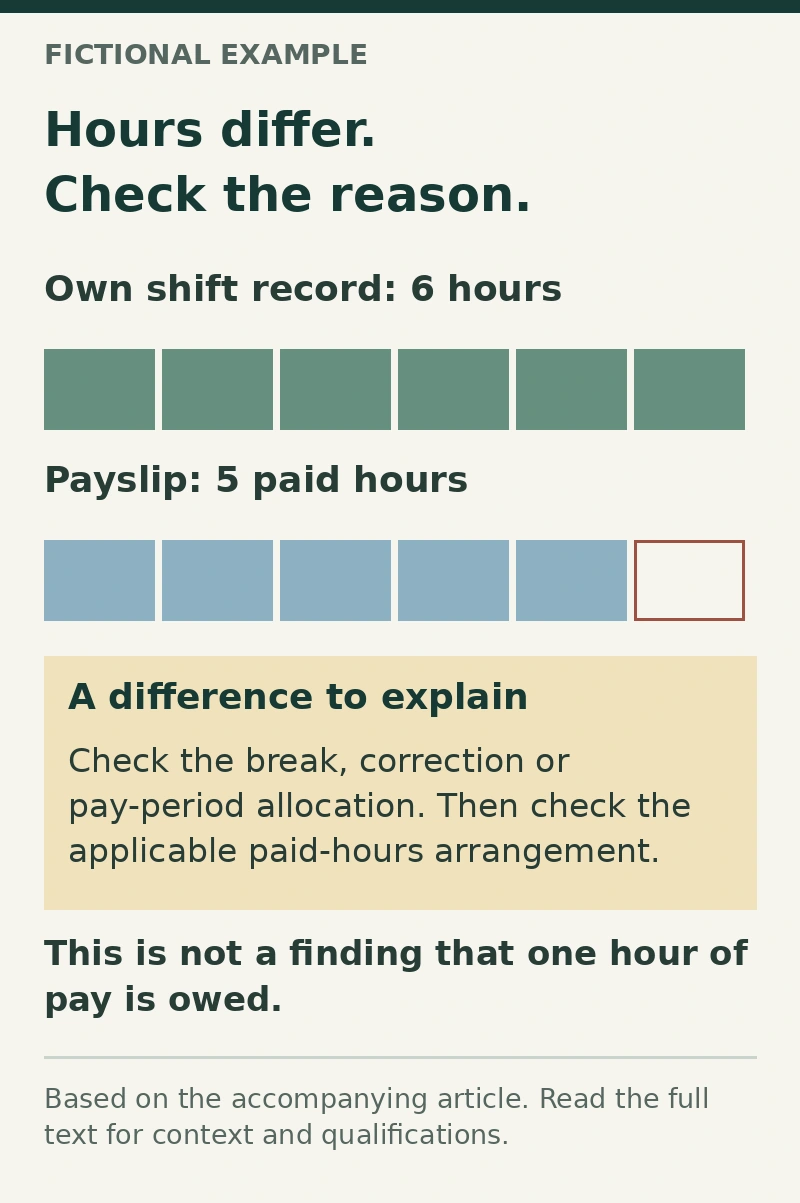
The following figures are invented to illustrate checking, not actual award rates or an entitlement finding.
Suppose Alex’s own record shows six hours worked on a particular shift, while the payslip records five. The first question is whether a break, correction or different pay-period allocation explains the difference. The second is whether the recorded paid hours match the actual applicable arrangement.
Alex can ask: “My shift record shows six hours between the recorded start and finish times. The payslip shows five paid hours. Could you explain the break or other adjustment used and confirm the time record for that shift?”
This is more precise than multiplying the difference by a guessed rate and presenting the result as a settled debt.
Record the response and correction
Keep the employer’s explanation and compare it with the evidence. If the issue is confirmed, ask what will be corrected, when and how it will appear in the records. Check the revised payment and any associated leave or super questions.
If the issue remains unresolved, put the remaining points in writing and use the relevant official assistance or advice pathway. Seek help promptly where circumstances make a direct workplace discussion inappropriate or difficult.
Keep the enquiry proportionate and factual
Separate what you observed, what the document states and what you are asking someone to determine. Avoid accusations based on an unverified classification or calculation. Equally, do not assume a vague assurance resolves a documented discrepancy.
The purpose of the bundle is to make the facts traceable so the correct rule and payment can be checked.