


Quantity surveyors work with the costs and commercial information of construction projects. When assessing a Brisbane vacancy, look beyond the title to the project stage, client or contractor setting, responsibilities and evidence the employer requests.
This guide explains the work and offers an original practice exercise. Use the actual advertisement and employer information to establish whether a position is available and what its requirements are.

Understand the cost-management work
The ABS quantity-surveyor description covers estimating, analysing and managing construction costs across project stages. The Australian Institute of Quantity Surveyors also describes work across feasibility, construction and the asset lifecycle.
Actual roles can emphasise cost planning, measurement, tender assessment, progress information or variations. Check which responsibilities belong to the advertised position and which decisions remain with a senior reviewer or another professional.
Avoid assuming quantity surveying means only counting materials. The context, assumptions and commercial implications of the information matter as much as the arithmetic.
Read the requirements as evidence requests
Check qualifications, relevant experience, software or measurement methods, reporting responsibilities and any professional or regulatory requirements applicable to the actual work. Ask for clarification where a title or credential is ambiguous.
An occupation classification is not an individual licence or a promise that a particular course will satisfy an employer. Verify the relevant pathway and recognition with the actual provider, professional body or authority where needed.
For experience, identify the stage and scope you personally handled. Distinguish preparing a measurement or cost record from independently approving a budget or commercial claim.
A fictional cost-change exercise
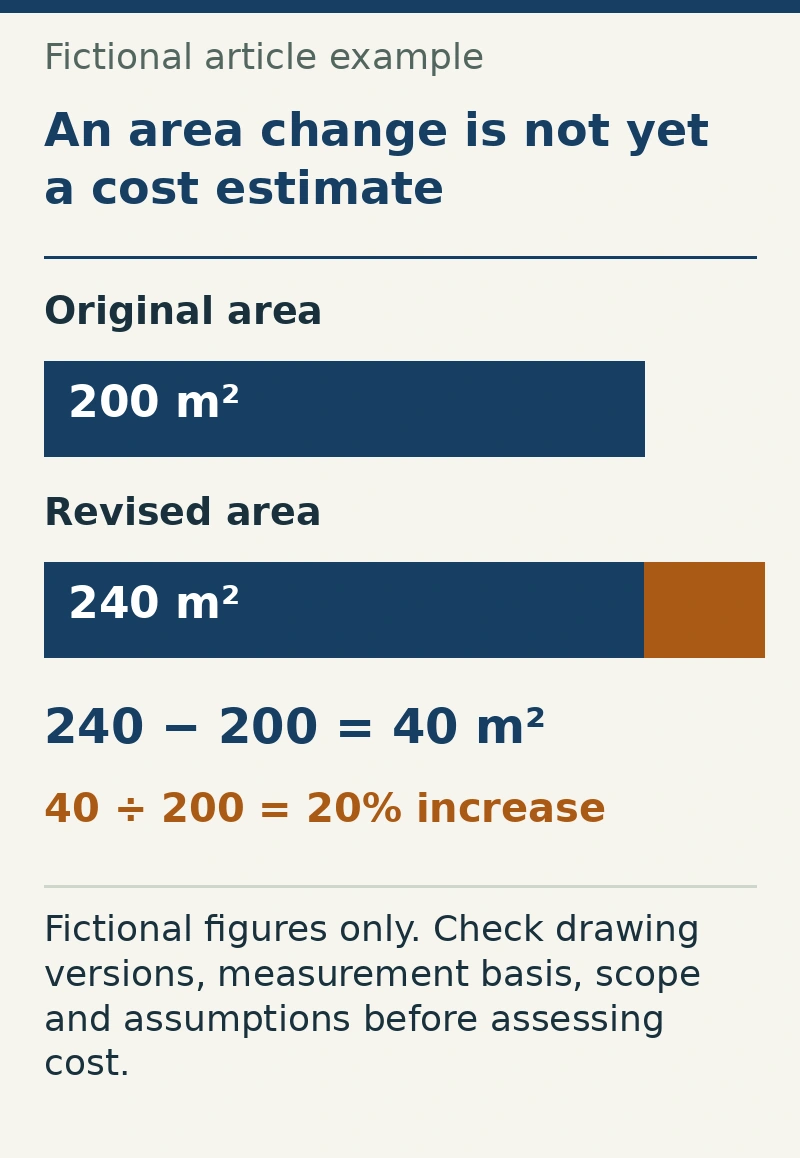
Imagine an invented project receives a design revision increasing a defined area from 200 to 240 square metres. The change is forty square metres, or 20% of the original area, under those fictional figures.
A useful practice note does more than apply a guessed rate. It identifies the drawing revisions, measurement basis, scope affected and information needed to assess cost. It flags whether related work, specification or assumptions also changed.
The exercise does not produce a quote or professional valuation. No real project, rate, cost or Games work is claimed.
Prepare a role-specific evidence sheet
For an authorised example from your own experience, record:
- Context: project stage and your actual responsibility.
- Inputs: drawings, specifications and information versions used.
- Method: measurement or cost-control approach within your competence.
- Checks: assumptions, reconciliation and review performed.
- Output: record or recommendation you prepared.
- Authority: who reviewed or decided the commercial outcome.
- Result: supported outcome, without invented savings or percentages.
Use fictional material for practice and obtain permission before sharing work samples. Remove sensitive pricing and client information through an appropriate process; superficial anonymisation may not be enough.
Ask questions about the working arrangement
Clarify the reporting line, review process, site involvement and balance between preparation and commercial decision-making. Ask how a new employee is introduced to the employer’s methods and project records.
Choose evidence that matches those responsibilities. A strong application explains how you produced reliable cost information, managed assumptions and recognised review limits, giving the employer something more useful than a list of software names or a claim of interest in Brisbane 2032.
For broader sector context, see the existing construction roles guide and compare its general information with the actual vacancy requirements.