



A proof of delivery record provides information about a carrier’s recorded handover or delivery event. Read it alongside the correct order, shipment and service information before using it to answer a customer or internal enquiry.
The record’s form and meaning depend on the service. Do not assume every delivery produces a signature or that one document resolves every question about quantity, condition, acceptance or liability.
Identify the actual record and service
Check the carrier, tracking or consignment reference, relevant shipment and recorded event. Confirm that the record belongs to the enquiry rather than another delivery with a similar order number.
Australia Post’s business portal guide gives one provider example of proof of delivery as an image or signature associated with the delivery. Other services can use different records and conditions.
Use the current carrier process and actual service terms for an enquiry. A general guide should not be treated as a legal interpretation of a particular delivery arrangement.
Read what the evidence actually shows
Identify the recorded date and time, location information, signature, image or other relevant event data available. Check any qualification or exception in the record.
Keep a carrier status, physical goods receipt and an authorised business acceptance decision distinct. They can be related records without answering exactly the same question.
If information is unclear or inconsistent, record the question and use the approved carrier or business enquiry route. Do not alter the record or fill a missing detail from memory.
A fictional record-check exercise
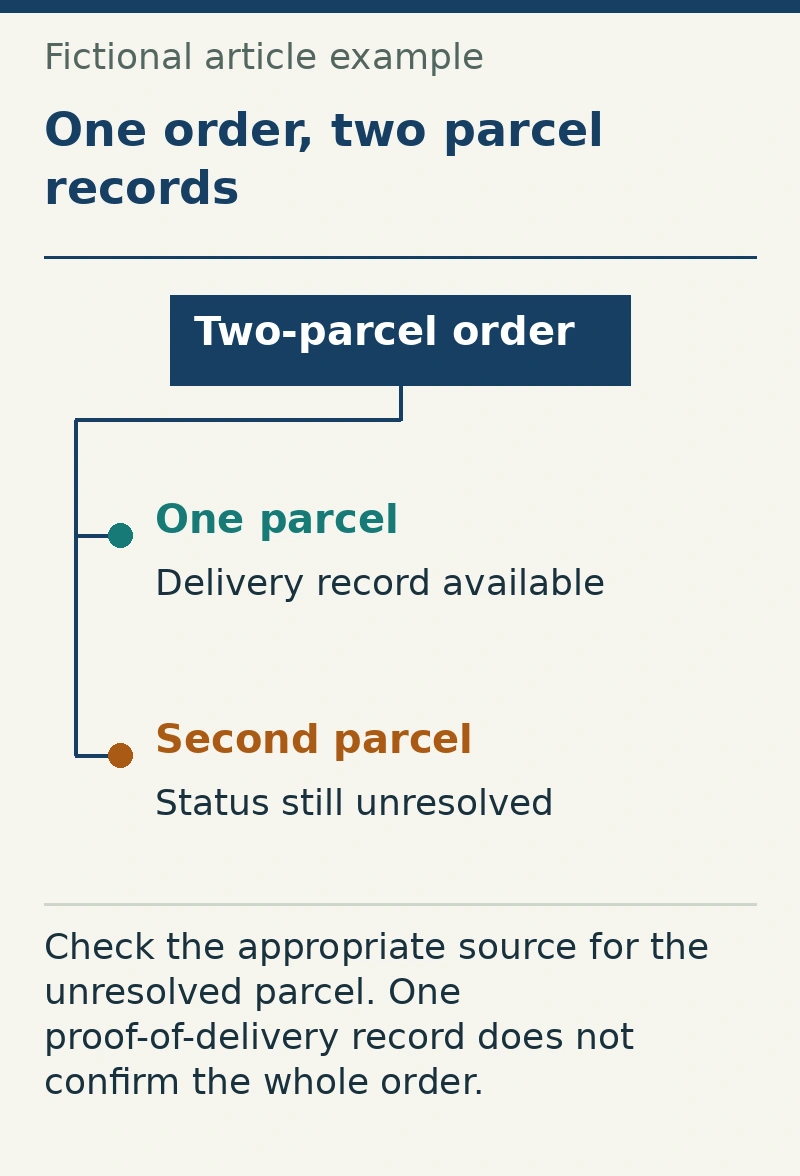
In this invented example, a customer asks about an order containing two parcels. The available record relates to one parcel reference, while the second reference has a different unresolved status.
The coordinator records what is known for each parcel and checks the appropriate source for the remaining enquiry. They do not describe the whole order as delivered merely because one proof-of-delivery record is available.
No actual parcel, customer, carrier finding or contractual outcome is claimed by the exercise.
Use a delivery-evidence review
Capture:
- Enquiry: the question and approved customer or order reference.
- Shipment: relevant parcel or consignment identifiers.
- Source: legitimate carrier record and access method.
- Event: what is recorded, with date and relevant qualifications.
- Comparison: order, dispatch or receiving information needed.
- Difference: missing, inconsistent or disputed detail.
- Follow-up: responsible owner and approved enquiry route.
- Outcome: verified response and remaining uncertainty.
Keep addresses, images, signatures and contact details in the appropriate restricted process. A general tracking spreadsheet does not need to expose all delivery evidence.
Close the enquiry with an accurate account
Explain the confirmed record and what is still being checked. Where a customer disputes the event or reports damage or a shortage, refer the matter through the applicable process rather than declaring the record automatically settles it.
Preserve original evidence and record the authorised outcome. Check relevant terms and obtain appropriate advice for a liability or other legal question.
A useful delivery-evidence review connects the correct shipment with the actual record and enquiry. It leaves another person able to understand what was verified and what remains open without turning a single delivery status into an unsupported conclusion about the whole order.
If delivery enquiries form part of your career plans, the guide to logistics coordinator roles provides broader context for shipment records and operational coordination.