A supply-chain analyst turns operational information into evidence for a defined business question. Read the vacancy for its data, process and decision-support responsibilities rather than assuming the role is only maintaining a stock spreadsheet.
Reliable analysis begins with understanding what each record represents. A precise average or dashboard can be misleading if orders, line items, shipments and deliveries are mixed without a clear definition.

Understand the analytical scope
The ABS supply-chain analyst description covers analysing supply processes, identifying improvements and supporting approved changes. Actual jobs may emphasise inventory, delivery, data quality or another operational area.
Check the employer’s required qualifications, systems, analytical methods and process experience. Ask who owns source definitions and who decides whether a recommendation is implemented.
The existing logistics coordinator guide gives related operational context, while an analyst vacancy needs evidence of its own data and reasoning responsibilities.
Define the question and comparison
Identify the measure, period, included records and relevant process stage. Check how missing, duplicated or changed records affect the result.
Do not compare two totals or averages until the source units and scope are understood. A delivery delay measure based on orders may answer a different question from one based on individual order lines.
Separate descriptive findings from an explanation of cause. A pattern can suggest a question worth investigating without proving why it occurred.
A fictional granularity exercise
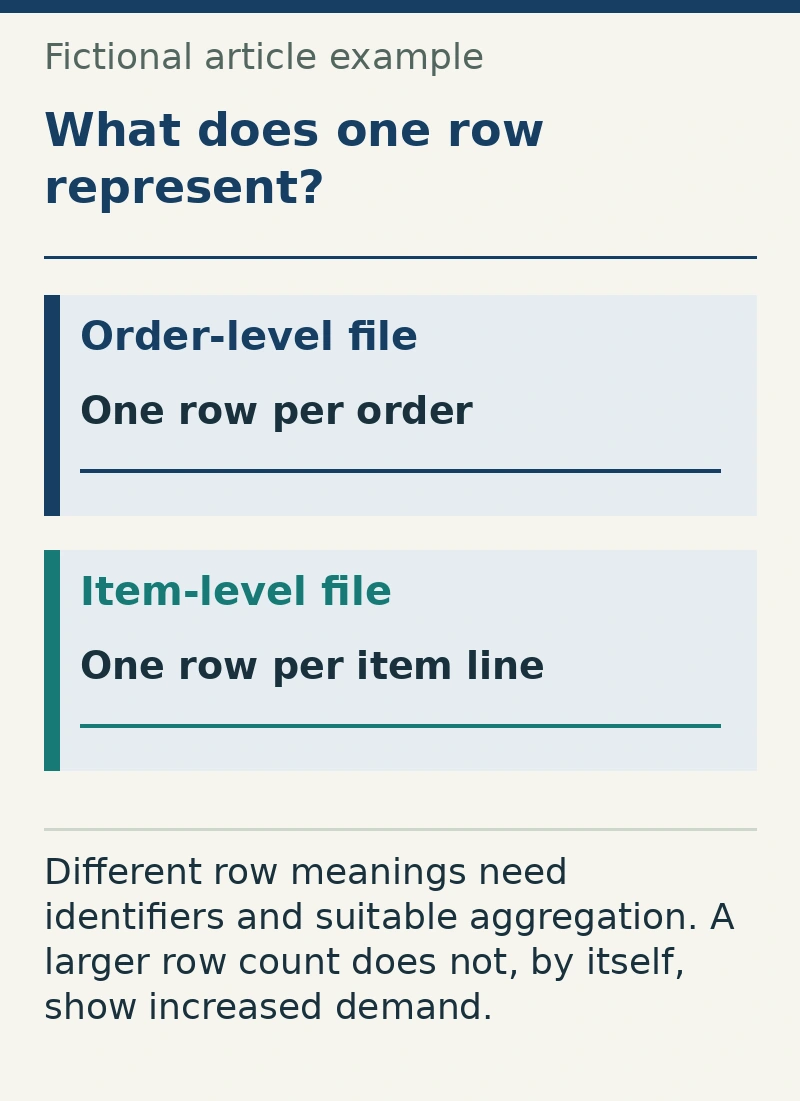
In this invented example, one dataset contains one row per order and another contains one row per item line. A candidate is asked to compare request volumes between them.
The analyst identifies the different record meanings and checks the identifiers and aggregation needed for a valid comparison. They do not present the larger row count as evidence that business demand increased.
The exercise contains no real business result, demand forecast or saving. It demonstrates how data understanding precedes calculation.
Build an analyst evidence sheet
For an authorised or fictional example, explain:
- Question and business decision supported.
- Source data, record meaning and relevant permissions.
- Quality checks and unresolved limitations.
- Method appropriate to the defined question.
- Finding and evidence supporting it.
- Recommendation, assumptions and actual decision owner.
- Follow-up and supported outcome within your role.
Protect customer, supplier and commercial information. Do not invent an efficiency percentage or attribute a whole organisation’s result to your analysis without evidence.
Ask about methods and accountability
Clarify data access, systems, stakeholder support and review arrangements. Ask how analysts handle conflicting definitions or information that does not support a requested conclusion.
Check whether the position mainly reports, investigates, models or supports implementation, and match your examples accordingly. A strong application explains how you made the analysis trustworthy and useful, preserving uncertainty and decision authority rather than presenting a polished dashboard as proof that a recommendation is correct.