



A shift handover should help the next person understand the current work, exceptions and actions they are responsible for. Write it for someone who was not present during the shift, using confirmed facts and the workplace’s approved handover method.
Do not rely on a general phrase such as “all good” when work remains open. Equally, avoid copying an entire shift diary when the next person needs a concise account of current status and priorities.

Start with the point in time
Identify the handover date, time, work area and people involved. State the period covered and distinguish completed activity from the situation at handover.
Use a clear status for each item: complete, in progress, awaiting a decision or needing verification. A task that was started is not necessarily ready for the next step.
Check the workplace’s required process for urgent, sensitive or safety-related matters. A routine handover note is not a substitute for immediate reporting or a specialist procedure.
A practical handover structure
Record:
- Current position: the work that matters at the shift boundary.
- Exceptions: departures from the expected arrangement, with facts checked.
- Next action: what needs to happen and by when.
- Owner: the person or role responsible for acting.
- Dependency: information, approval or resources still needed.
- Evidence: the approved record or reference supporting the update.
- Escalation: the contact or process if the next step cannot proceed.
Use only information needed for continuity. Keep personal, financial or other restricted details in the approved record rather than repeating them in a broadly shared handover.
A complete fictional handover example
This original office scenario is invented:
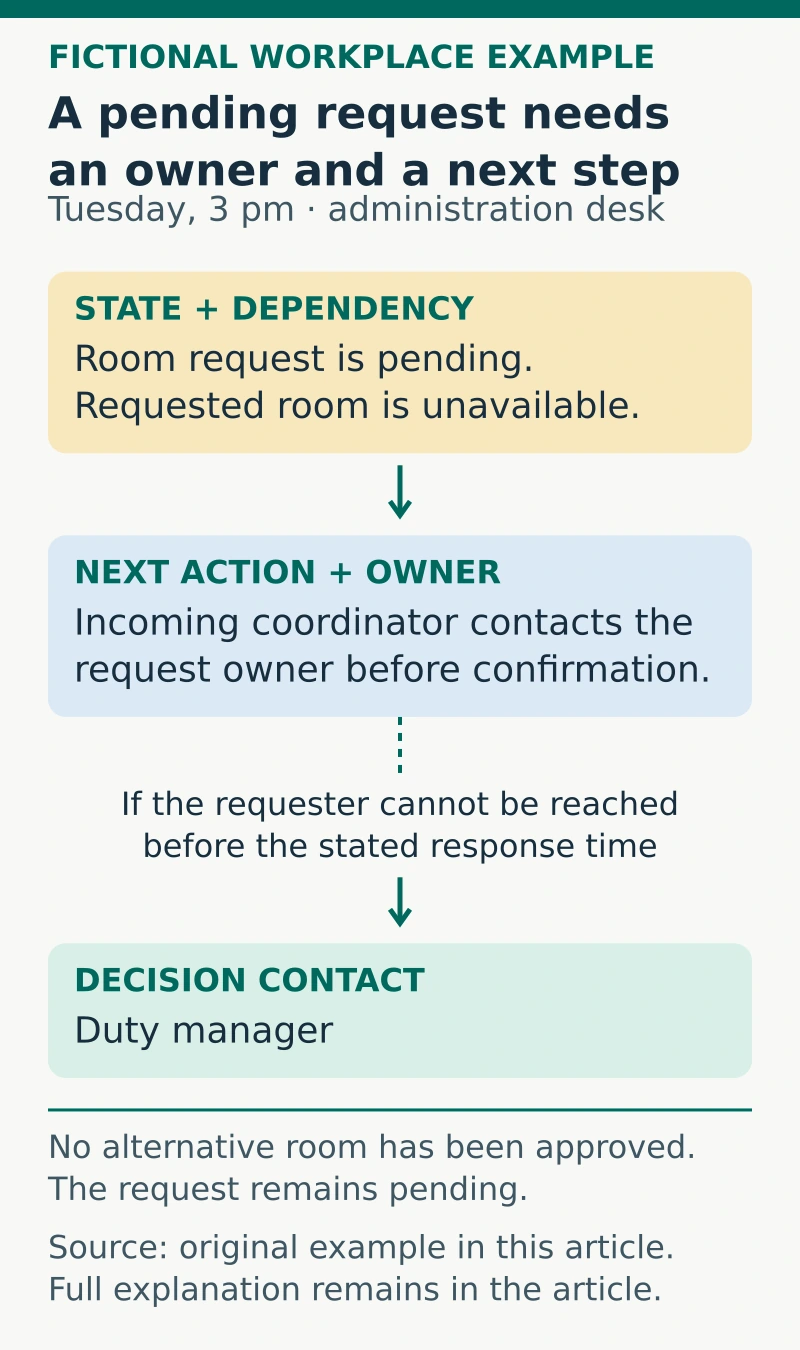
“Handover, Tuesday, 3 pm, administration desk. The room-booking summary is complete and stored in the approved booking folder. One request remains unconfirmed because the requested room is unavailable.
“Next action: the incoming coordinator should contact the request owner before issuing a confirmation. The request is recorded as pending; no alternative room has been approved. The duty manager is the decision contact if the requester cannot be reached before the fictional 4 pm response deadline.”
The note describes the actual state, next action and authority limit. It does not quietly turn a proposed alternative into a confirmed booking.
Confirm understanding for important open items
Where the handover process includes a conversation, ask the incoming person to identify the next action and any uncertainty. Correct differences before assuming the work has transferred.
Comcare’s effective communication guide provides broader guidance on shared understanding of work. Adapt the communication method to the actual task, including any required records and checks.
If the incoming person lacks access, information or authority, identify the issue and responsible contact. Merely placing their name beside an action does not resolve those gaps.
Update rather than accumulate stale notes
Close resolved items through the approved process and retain the record as required. If an item continues across several shifts, make its current status visible instead of copying a growing chain of contradictory updates.
Review recurring handover questions for unclear procedures or missing ownership. A good handover allows the next person to continue appropriately, recognise what remains uncertain and know when another decision is required.
For a broader shift-work context, see major-event workdays, briefings and responsibilities; a real workplace’s handover and safety procedures still take priority.