




A recruitment budget should show the resources needed to complete a hiring process, the assumptions behind the estimate and the person authorised to approve spending. Begin with a defined vacancy and recruitment route, then separate external payments from internal time.
This guide provides an original planning method and fictional arithmetic. It does not state market recruitment prices, a required budget or the cost of using Brisbane Olympic Jobs.

Define the decision and its limits
Record the role, number of positions, proposed process and target start period. Identify who may authorise advertising, agency work, assessment expenses and onboarding purchases. An approved headcount does not necessarily approve every later expense.
Business Queensland’s hiring guidance describes recruitment as a planned process, including identifying needs, selection and onboarding. Use the actual process chosen by your business when estimating its resources.
Distinguish the cost of filling the vacancy from the ongoing employment budget. Wages and employment on-costs need their own verified assumptions; they should not disappear merely because this worksheet focuses on recruitment.
List the work and who performs it
Follow the process from approval to a supported start. Possible categories include advertising, an agreed agency service, staff time for screening and interviews, necessary assessment arrangements, checks, candidate communication and onboarding preparation. If Brisbane Olympic Jobs is one advertising option, review our employer advertising page and confirm the current service and price before including a real amount in the budget.
Include only applicable items. Check whether a quoted service already includes an activity before adding it again. Record uncertainty explicitly rather than entering zero for an expense that has not been investigated.
For internal time, identify the number of people, hours and planning rate used. That estimate can help compare approaches even when no separate invoice is issued.
A fictional budget calculation
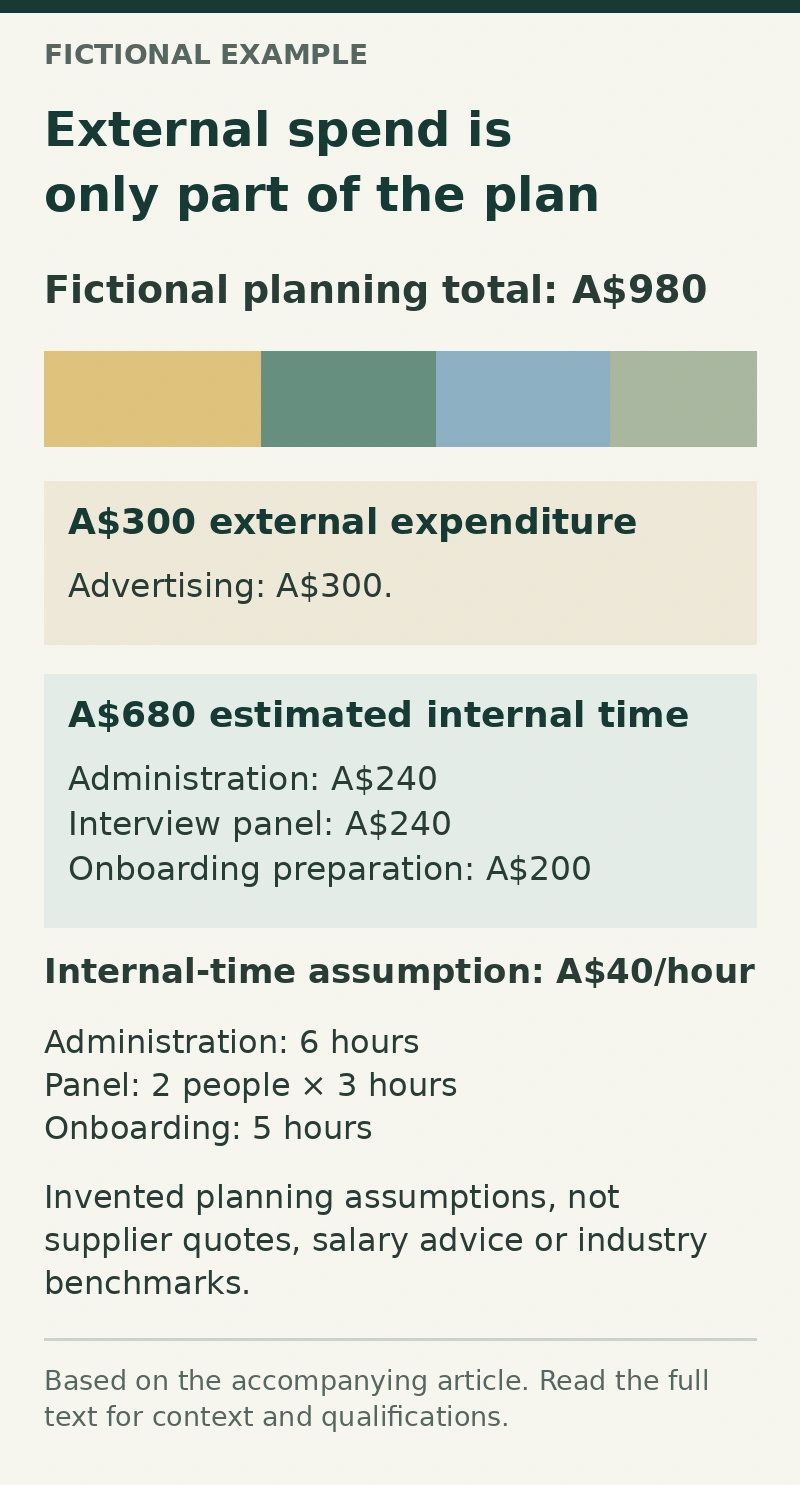
In this invented example, a small business estimates:
- Advertising: A$300, used only as a fictional planning amount.
- Recruitment administration: six hours at an assumed A$40 per hour, or A$240.
- Interview panel: two people for three hours each at the same assumed rate, or A$240.
- Onboarding preparation: five hours at that assumed rate, or A$200.
The illustrative total is A$980: A$300 in external expenditure and A$680 in estimated internal time. These figures are not salary advice, supplier quotes or industry benchmarks. Replace every assumption with information suitable for the actual business.
If another service is proposed, show its scope and quotation separately. Do not present an unconfirmed amount as approved spending.
Add uncertainty without hiding it
Identify events that could change the estimate, such as repeating an advertisement or arranging an additional assessment session. Show the trigger, possible resource impact and person who would decide whether to proceed.
If a contingency amount is included, label its purpose and approval conditions. A contingency should not become an unexplained percentage that obscures what the business expects to buy.
Review actual effort after the hire
Record actual invoices and time using the same categories as the estimate. Explain differences, including activities removed or repeated. Keep candidate information out of a widely shared budget summary.
Use the result to improve the next estimate rather than declaring the cheapest process the best. A useful budget makes the trade-offs visible: spending, staff capacity, process accessibility and the support required for the new starter. Close the worksheet with the approved amount, remaining uncertainty and next review point.