


In stock control, FIFO means first in, first out: using or allocating eligible stock in receipt order. FEFO means first expiry, first out: prioritising eligible stock by its expiry date. The appropriate method depends on the goods and the approved inventory process.
Neither label overrides a recall, quality hold, storage requirement or other restriction. A rotation sequence only applies to stock that is actually available and suitable for the intended use.

Understand which date matters
Under FIFO, the relevant sequence concerns when stock came in. Under FEFO, an earlier expiry date can take priority even if that batch arrived later.
Business Queensland’s stock-control guidance discusses FIFO stock rotation. The GS1 retail systems playbook also describes expiry and batch information supporting FEFO and inventory controls.
Check the actual product information and workplace instructions. Do not assume every printed date is an expiry date or that a date-free item should be given an invented one.
A fictional comparison
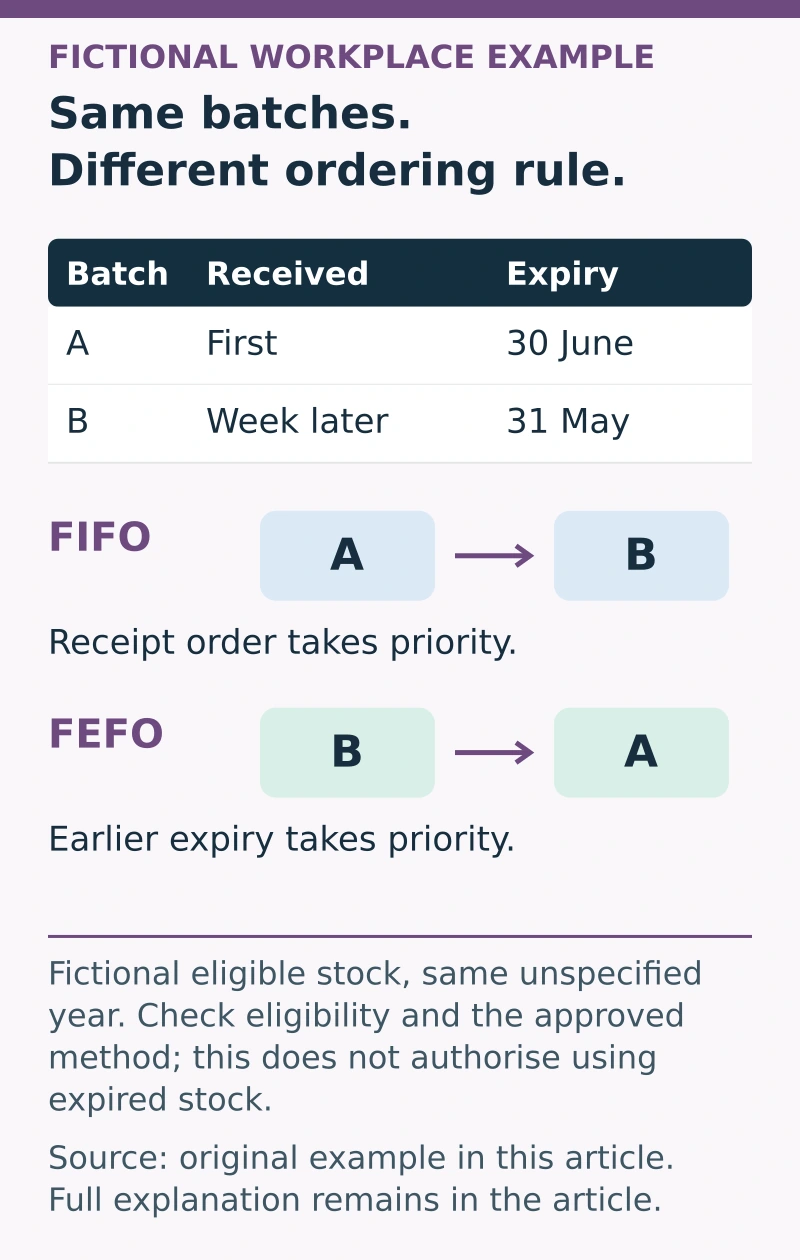
Suppose an invented stockroom receives Batch A first and Batch B a week later. The fictional product labels show Batch A expiring on 30 June and Batch B on 31 May of the same year.
If both batches are eligible and the approved process uses receipt order, FIFO would place Batch A first. Under FEFO, Batch B would take priority because its expiry is earlier.
This example explains sequence only. It does not state that either batch may be supplied on a particular date, determine a food-safety rule or authorise using expired stock.
Keep product and batch identity clear
Record the item, batch or lot where relevant, receipt information, expiry information and storage location through the approved system. The unit and product identity must be consistent across records.
Avoid combining batches in a way that loses traceability. If a label is unreadable or the record conflicts with the goods, refer the issue rather than choosing whichever date makes the rotation easier.
Physical arrangement should support safe, authorised work. This article does not provide storage-temperature, stacking or manual-handling instructions.
Use a practical rotation check
Before allocation, ask:
- Identity: is this the correct product and batch?
- Eligibility: is it released for the intended use under the actual process?
- Rule: does the approved method use receipt or expiry order?
- Data: are the relevant dates and quantities verified?
- Exception: is there a recall, hold, damage or other restriction?
- Record: how will the movement and remaining balance be captured?
Do not silently replace the approved method when the oldest stock is difficult to reach. Raise the layout or process issue with the responsible person.
Review exceptions and records
Where stock cannot be used in the expected sequence, record the reason and authorised decision. Update movements accurately so the next person does not rely on a balance or batch location that no longer applies.
Review recurring expiry or identification problems with the stock owner. The improvement may involve purchasing quantities, delivery information, layout or record quality. FIFO and FEFO are useful principles when the product data, eligibility checks and actual work process support them.
Our guide to warehouse roles and duties provides wider job context for these stock-control concepts; product-specific training and workplace rules remain essential.