




A recruitment funnel summarises how applications move through defined stages. It can help an employer investigate where a process slows or where information is missing, but it does not explain the cause of every change in numbers.
Begin with consistent definitions and a complete reporting period. A spreadsheet containing several different versions of “shortlisted” will produce precise-looking percentages that are difficult to interpret.

Define the stages and counting unit
Decide whether the report counts people, applications or vacancies. One person applying for two jobs should not become two people unless the report explicitly uses application counts. If the funnel includes agency referrals as well as direct applications, clarify the recruitment route and responsibilities described in our recruitment agencies guide before combining records from the two sources.
Define entry to each stage: received, eligible for assessment, interviewed, offered and accepted, for example. Record withdrawals separately where practical so they are not silently treated as employer rejections.
Use comparable recruitment exercises when combining results. A completed vacancy and a newly advertised vacancy have had different opportunities to reach later stages.
A fictional funnel
Suppose an invented completed process contains forty applications, twelve interviews, three offers and two accepted offers. For this exercise, every application represents a different person and the stages are counted consistently.
The interview-to-application conversion is twelve divided by forty, or 30%. The offer-to-interview conversion is three divided by twelve, or 25%. The acceptance-to-offer conversion is two divided by three, approximately 66.7%.
Those results describe this fictional process only. They are not Brisbane employment statistics or recommended industry targets. Two accepted offers out of forty applications is 5%, but that overall figure answers a different question from offer acceptance.
Keep the denominator visible
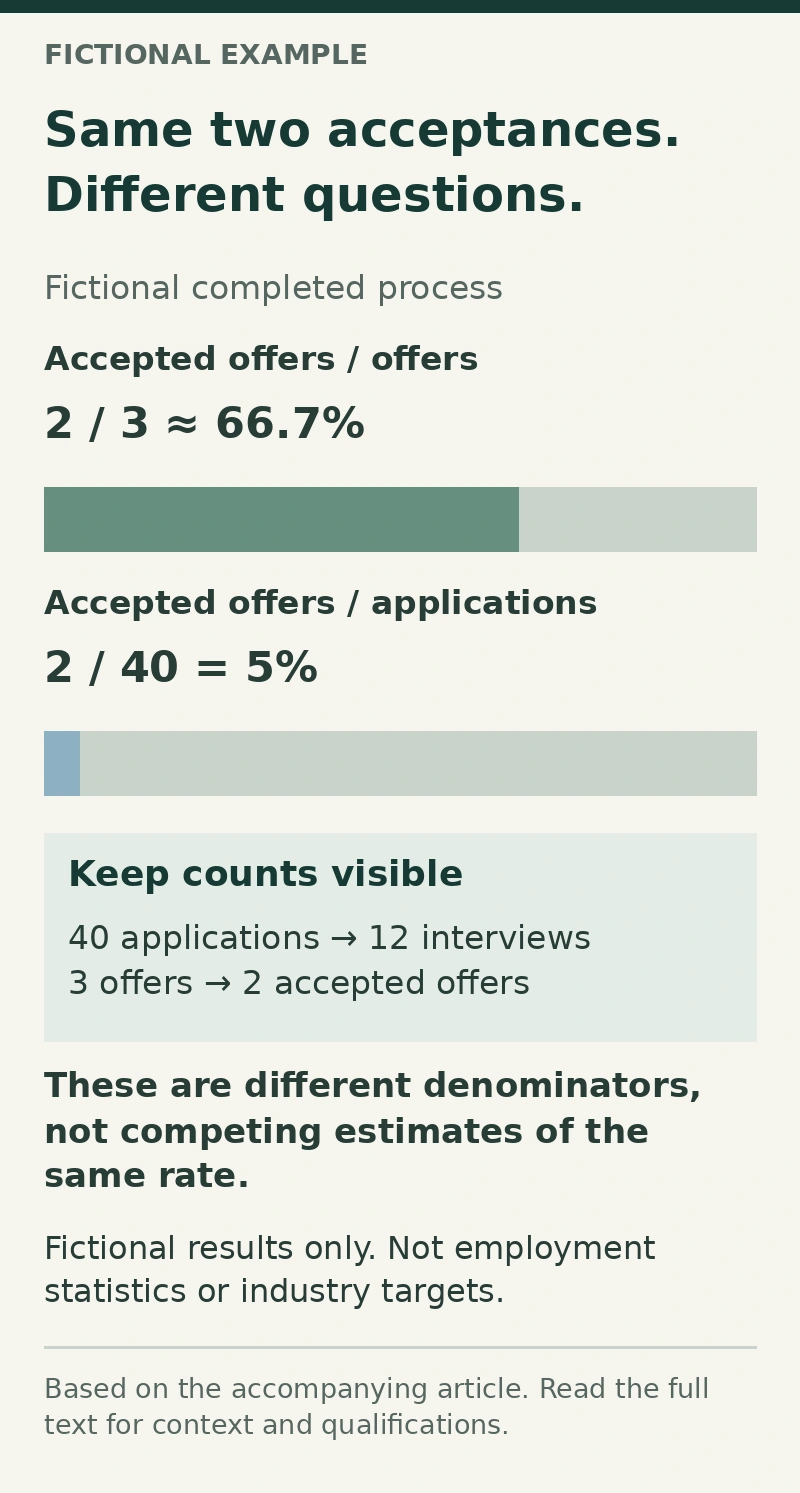
Label every percentage with its numerator and denominator. “Acceptance rate” without a definition could refer to offers accepted, candidates attending interviews or something else entirely.
Check incomplete outcomes. If one offer is still awaiting a response, presenting it as a declined offer can distort the result. Show the pending count and reporting date rather than forcing every record into a final category.
For small groups, show counts alongside percentages. A change involving one person can look dramatic as a percentage without indicating a repeatable pattern.
Turn a number into an investigation
Use an original review record:
- Observation: the count, percentage and reporting period.
- Definition check: whether stages and data are consistent.
- Possible explanations: alternatives to investigate, not proven causes.
- Evidence needed: records or feedback that could distinguish them.
- Action owner: who will investigate and report back.
- Review: when the process change will be checked.
For example, a lower interview-attendance count might prompt a check of invitation delivery, scheduling and access arrangements. It does not prove candidates lacked commitment.
Use measures to improve the process
Do not treat the highest application count or fastest hire as automatically best. Review whether the process assessed the role requirements clearly and gave candidates a usable way to participate.
Business Queensland’s hiring guidance provides context for the stages involved in recruitment. Choose measures that help answer a real process question within those stages.
Share summaries with appropriate privacy protections and keep individual assessment decisions in their proper records. A useful funnel leads to a testable question and an owned action, rather than a league table of candidates or unsupported claims about recruitment performance.