A completed hiring process offers evidence about the process itself: whether the role was clear, arrangements worked, decisions moved through approval and candidates received accurate information. Review those activities separately from deciding whether an individual applicant should have been selected.
An original recruitment retrospective can be short, but it needs records, a defined question and someone responsible for the changes agreed. A meeting that ends with “communicate better” has not yet produced a usable improvement.

Set the review scope
Choose one completed recruitment exercise and identify the stages covered. Include the people who coordinated the process, made decisions or implemented assessment arrangements. Consider candidate feedback where it has been obtained appropriately.
State what the review will decide. Examples include improving invitation accuracy, reducing avoidable approval waits or making assessment instructions clearer. An active complaint or disputed selection decision may need its own formal pathway and should not be disposed of through an informal retrospective.
Business Queensland’s hiring guidance describes activities from identifying a need to onboarding. Use the relevant stages as a map, not a requirement to discuss every possible recruitment issue at once.
Reconstruct what actually happened
Prepare a timeline using approved records. Include planned and actual dates, changed instructions, communication points and unresolved dependencies. Separate a documented event from a participant’s interpretation of it. Where an agency participated, use our recruitment agencies guide as context for checking the agreed division of work, then review the actual handovers rather than attributing a delay to an entire channel.
In a fictional example, the record might show that interview invitations were sent before a meeting link was confirmed. Candidates then received two updates. That is evidence of a sequencing problem; it is not evidence that the administrator was careless or that candidates were unable to use technology.
Avoid circulating complete applications or sensitive adjustment information when a process summary will answer the question.
Ask questions that lead to changes
Use this original agenda:
- What was the intended process and where did it change?
- Which instructions or approvals were unclear?
- Were candidates given accurate preparation and contact information?
- Did any format, timing or access barrier need a different arrangement?
- What evidence supports each proposed explanation?
- Which change is within the team’s authority to make?
Allow different accounts to be recorded without treating the most senior person’s recollection as the only evidence. Where information is missing, assign a check rather than filling the gap with a confident story.
Convert one finding into an owned action
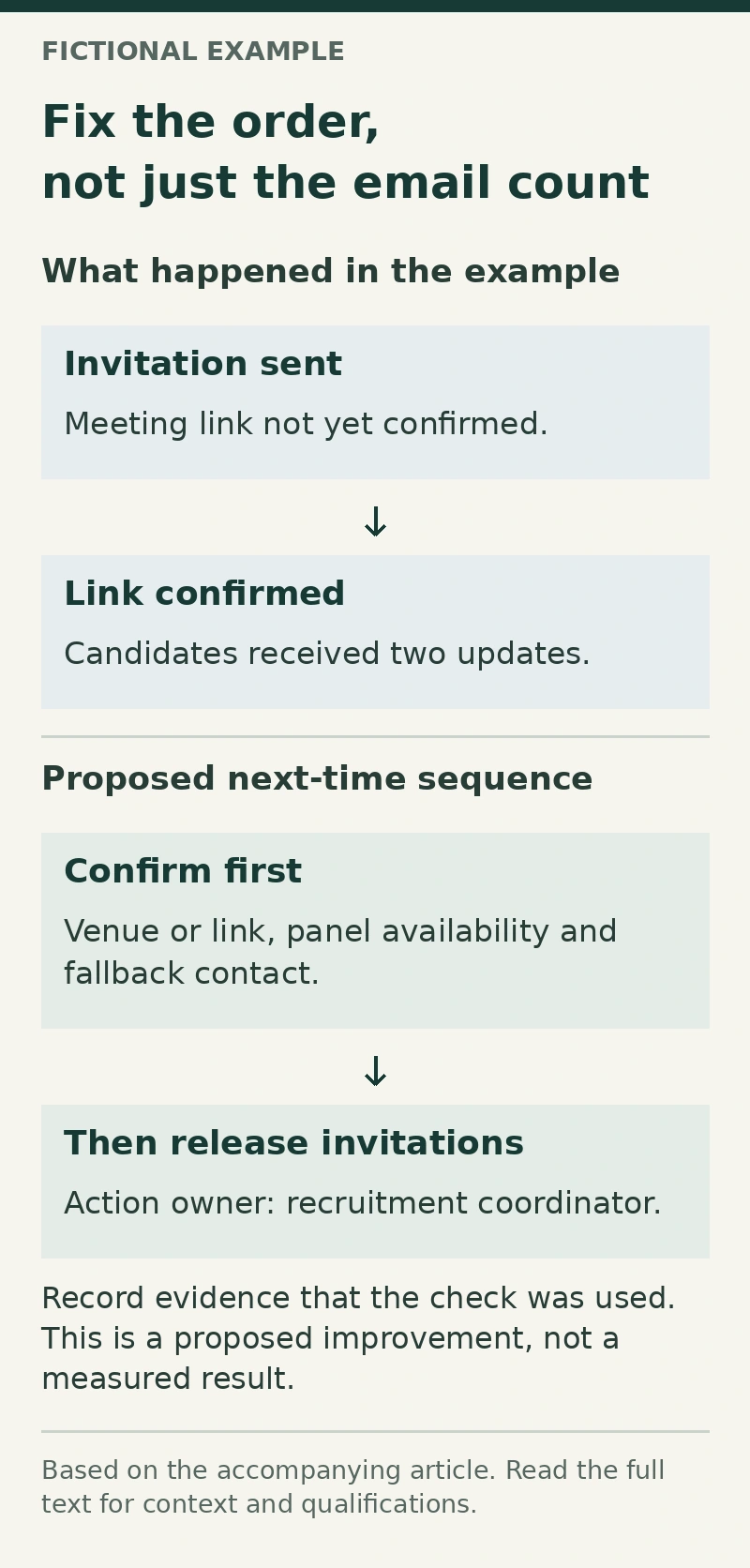
For the fictional invitation problem, a useful action might be: the recruitment coordinator will use a confirmation check covering venue or link, panel availability and fallback contact before invitations are released.
Record the owner, completion point and evidence that the check has been used. The action addresses a defined failure in the sequence. “Send fewer emails” would be less useful if the extra emails were correcting necessary information.
Check whether the next process improved
Agree how to review the change during the next relevant recruitment exercise. Look at the outcome the action was designed to affect, including whether it created new delays or barriers.
Close the retrospective with a short decision record, unresolved questions and review dates. Keep individual candidate assessments and personal information in the appropriate restricted records. The value of the review lies in a better-defined next process, with evidence that someone has implemented the change.