A timesheet approval process should preserve an accurate account of work performed while giving payroll a clear way to identify missing information and resolve errors. Set responsibilities for recording, checking, correcting and approving time before the first pay-cycle deadline.
Do not change recorded hours simply to match a roster, budget or manager’s expectation. A roster is planned work; a time record concerns what actually occurred and the information required under the applicable rules.

Define what needs recording
Check the applicable award or agreement, employment arrangements and payroll requirements. Identify the relevant hours, breaks, additional work and other information needed for the employee and pay calculation.
The Fair Work Ombudsman’s record-keeping guidance describes time and wages record obligations, including accuracy and limits on altering records. Use that guidance and the applicable requirements to design the process rather than assuming one timesheet format suits every arrangement.
Explain the recording method to employees and provide an accessible way to raise a problem with the system or a disputed entry.
Separate recording from approval
Identify who enters the time, who checks it and who may approve payroll processing. Set a cutoff that allows questions to be investigated, along with a backup contact if the usual approver is unavailable. For staff taking on payroll-support duties, our administration roles guide helps distinguish administrative work from the approval authority that must be confirmed within the employer’s own process.
An approval should confirm that the required checks have been completed. It should not erase an unresolved question or imply the employee has waived an entitlement.
Where an entry is late or incomplete, use a defined escalation and correction process. Do not assume the appropriate response is automatically to omit the work from pay.
Use a practical exception record
For an entry needing review, record:
- Employee and period: the correct authorised identifier and pay period.
- Entry: the time or detail that needs checking.
- Question: what is missing, inconsistent or disputed.
- Evidence: relevant records and the employee’s explanation.
- Decision: correction or further action and the authorised person.
- Record: how the original issue and correction are documented.
- Payroll follow-up: any pay calculation or communication still required.
Keep the information in the approved restricted process. A shared operational roster does not need to display every payroll enquiry.
A fictional discrepancy
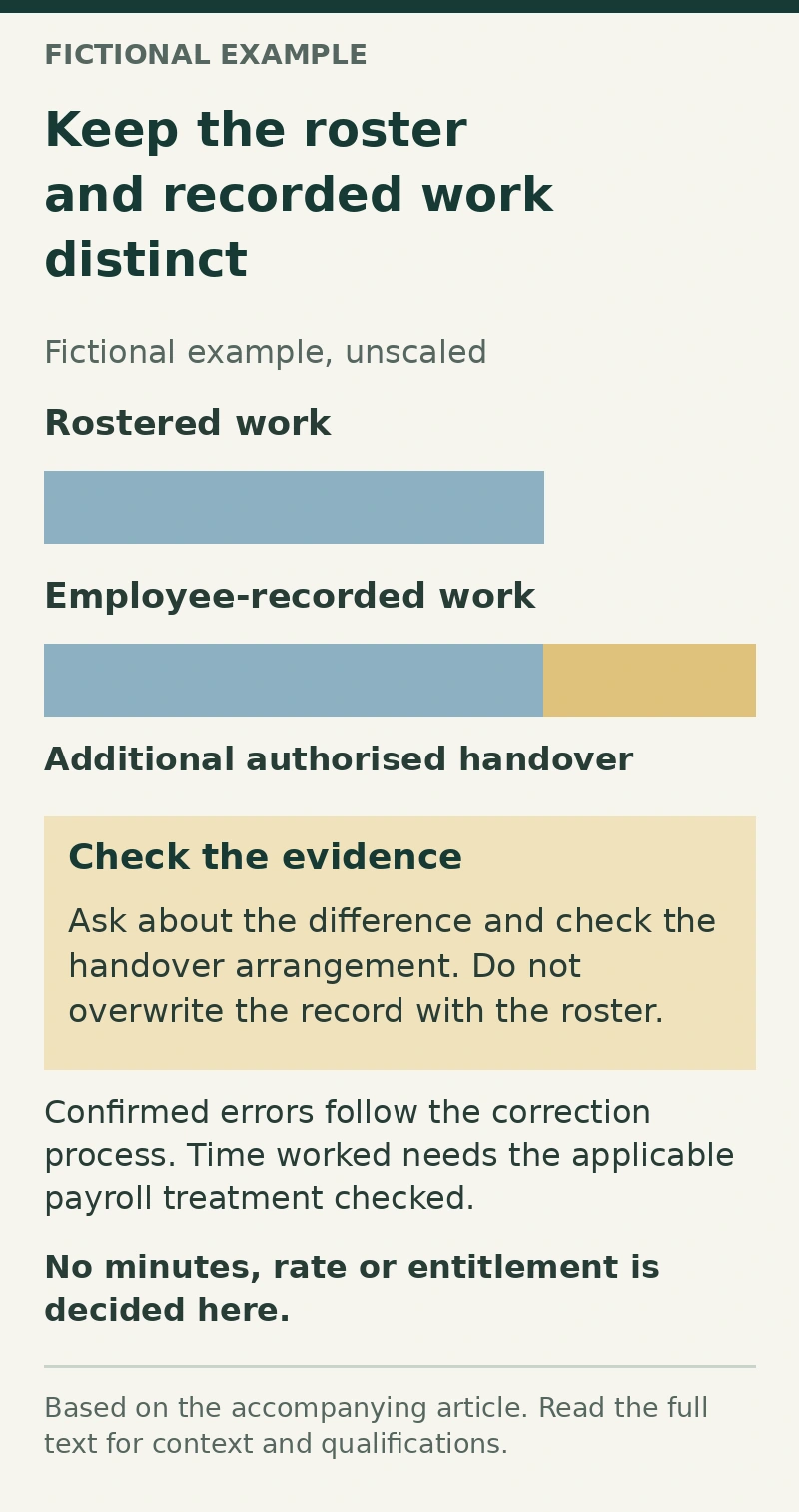
In this invented example, an employee records an additional period spent completing an authorised handover. The roster shows the earlier finishing time. The approver asks about the difference and checks the handover arrangement rather than replacing the entry with the rostered time.
If an error is confirmed, it is corrected through the proper process with an explanation. If the time was worked, payroll checks the applicable treatment. A separate concern about whether extra work was authorised should not be resolved by deleting hours that were actually worked. This example does not decide the rate or entitlement for a real employee.
Make correction and follow-up visible
Explain how an employee can report an error after approval and how payroll will acknowledge, verify and respond. Restrict editing permissions appropriately while keeping a workable way to correct mistakes.
Check recurring exceptions for process problems, such as unclear handover expectations or an unusable recording method. Improve the instructions or system instead of repeatedly requiring informal fixes.
A dependable approval process can explain who recorded the time, what was checked and how an issue was resolved. The goal is accurate records and correct processing, with a clear path for questions that remain open.