

A metric definition explains what a measure means and how it is calculated so different people can reproduce the same result. Write it before building a dashboard or comparing performance across periods.
A familiar label such as completion rate is not enough. The team needs to know which records qualify, which stage counts as complete and what period or denominator applies.

Begin with the decision the measure supports
Identify the question and audience. A measure for reviewing service demand may need a different definition from one used to track a specific response commitment.
Describe one record’s meaning and the source that determines its status. Check whether a person, request, transaction or work item is being counted. Do not switch between these units without changing the definition explicitly.
The Australian Bureau of Statistics offers guidance on understanding statistics. Its broader statistical-literacy context supports asking what the data represents; the metric record below is an original workplace example.
Use a metric-definition record
Include:
- Name: a clear label that matches the actual measure.
- Purpose: decision or review question supported.
- Unit: what one counted record represents.
- Calculation: numerator, denominator and any conversion.
- Scope: included and excluded records.
- Time: reporting period and relevant cutoff.
- Source: approved fields and extraction or review method.
- Quality: missing, duplicate or unresolved records and their treatment.
- Owner: person approving and maintaining the definition.
- Change: version, effective date and comparability implications.
Keep the definition available to report users. A formula hidden in one analyst’s workbook is difficult for another person to assess.
A fictional measure
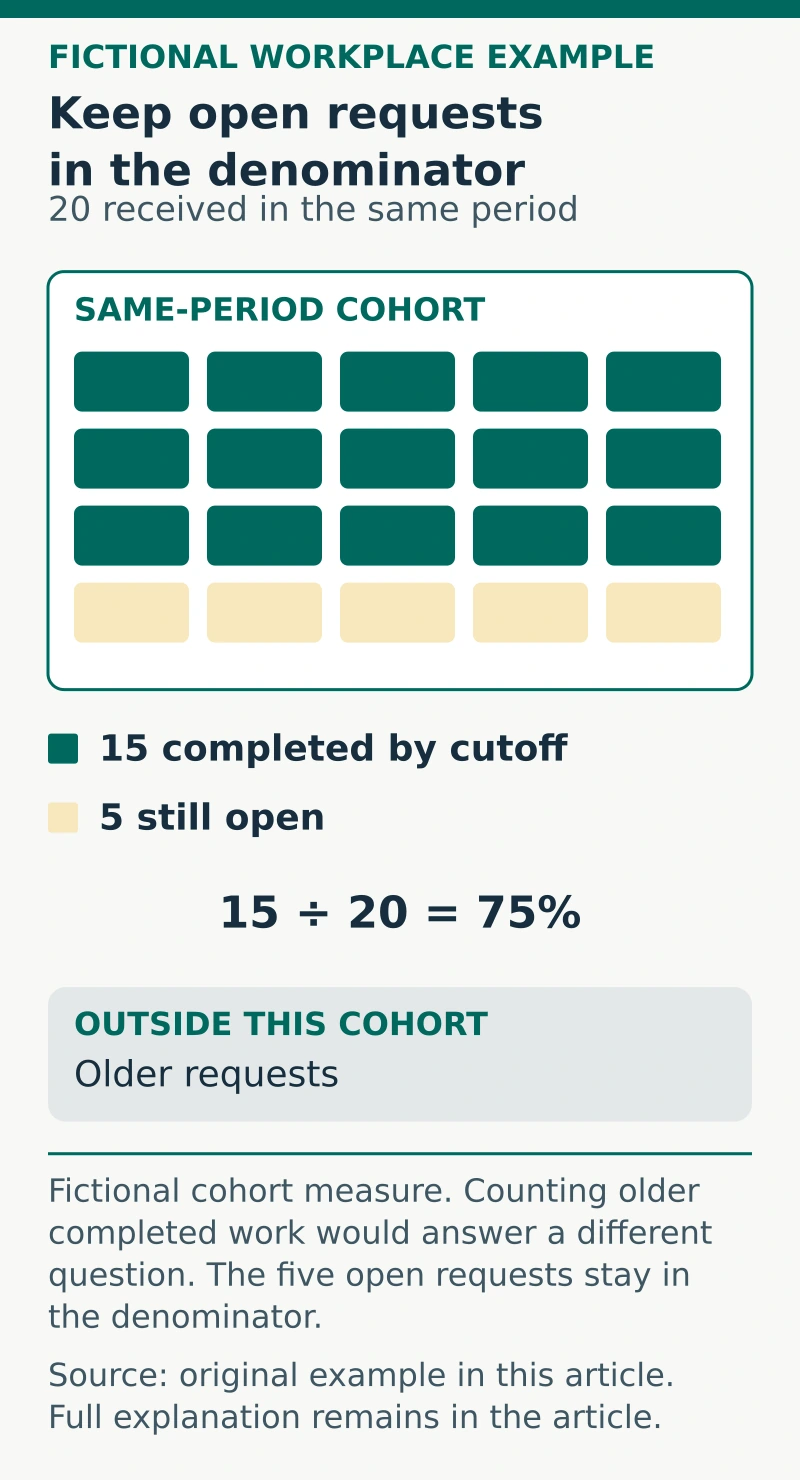
An invented office wants to report the share of requests completed during a defined review period from the set received in that same period. The definition specifies twenty received requests, of which fifteen meet the agreed completion condition by the cutoff.
The result is fifteen divided by twenty, or 75%. The remaining five are not silently excluded because they remain open.
This is a fictional cohort measure. Counting all work completed during the period, including older requests, would answer a different question. The definition needs to make that distinction explicit.
Test edge cases before reporting
Decide how cancelled, reopened, duplicated or transferred requests are treated under the actual purpose. Check a small fictional set containing those cases and ask another reviewer to apply the definition. For a data-skills example, our practical workplace skills guide can help you describe how another person reproduced the measure and which ambiguous cases you clarified, rather than listing reporting software alone.
If two reviewers obtain different results, identify the ambiguous rule rather than averaging their answers. A definition should resolve the calculation or mark the uncertainty for the responsible decision-maker.
Avoid comparing teams whose source processes differ until the relevant effects have been assessed. The same label does not ensure the same data basis.
Maintain the definition as work changes
Review it when fields, systems, workflows or reporting needs change. Record whether a revision affects comparison with earlier periods and explain that in the report where necessary.
Check the actual output against the agreed calculation and source records. A useful metric is reproducible and understandable, with a clear owner for questions. It should help people assess the work rather than create a precise-looking number whose meaning changes between reports.