


Verify a job offer through contact details you find independently before sending money, identity documents or account information. A familiar logo, an ABN or an advertisement on a recognised platform does not prove that the person contacting you represents the real employer.
Scamwatch’s employment-scam guidance warns about impersonated recruiters, fake task-based jobs and requests to pay money to unlock earnings. Pause the conversation if the proposed work depends on topping up an account or transferring money for someone else.

Check the organisation and the person separately
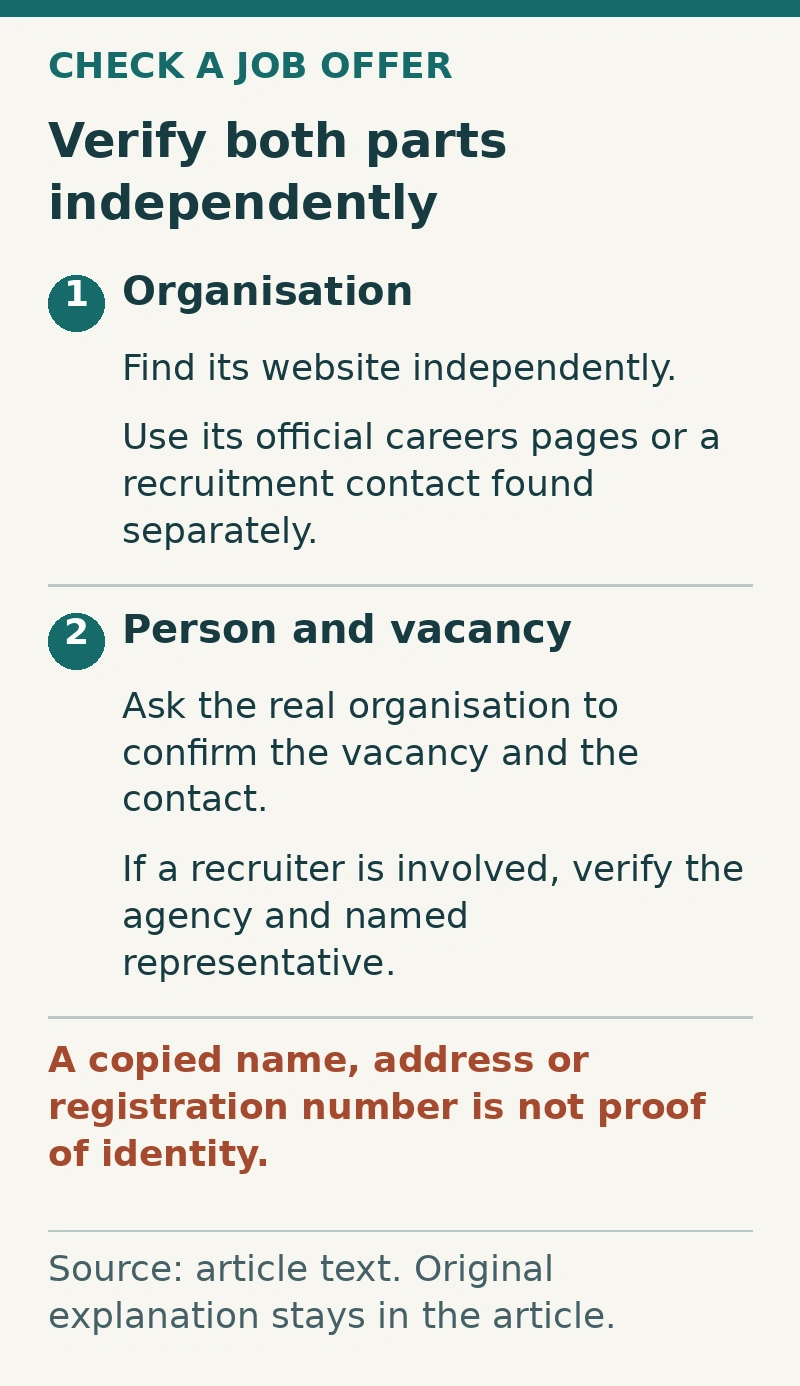
Find the employer’s website independently rather than using a link supplied in the message. Look for the vacancy on its careers pages or confirm it with the recruitment team using a number obtained separately. If a recruiter is involved, verify the agency and the named representative.
Do not treat copied business details as proof of identity. A scammer can copy the name, address and registration number of a legitimate business. What matters is whether the real organisation confirms the vacancy and the contact.
An unusual email domain or a move straight to an encrypted messaging service deserves investigation, but one detail alone is not a complete verdict. Verify the whole arrangement before proceeding.
Ask what the proposed work actually involves
Request the role description, legal employer, location, employment arrangement and recruitment process. Be cautious when the answer stays vague but the promised earnings become more specific.
Separate normal recruitment from a request to handle money, cryptocurrency, purchases or packages for strangers. Do not test the arrangement by sending a small amount. A small initial payment from the other person is not evidence that later deposits are safe.
A fictional verification scenario
A fictional applicant, Jordan, receives a message offering remote “product optimisation” work. The sender uses a well-known retailer’s logo and says Jordan can begin immediately. After a short demonstration, the platform asks Jordan to deposit funds to release a larger balance.
Jordan does not deposit money or upload identification. Instead, Jordan finds the retailer’s official careers contact independently and asks whether the role and sender are genuine. The retailer cannot confirm them. Jordan saves the messages and reports the account and offer through official channels.
This is an invented teaching example, not a report about a particular retailer. The warning pattern is the payment arrangement and failed independent verification, not the applicant’s experience level or the promise of working from home.
Use a stop-and-check checklist
- Can I confirm the vacancy through an independently located employer or agency contact?
- Does that organisation confirm the person, email domain and application channel?
- Are the duties and employment terms clear enough to assess?
- Am I being asked to pay, top up an account or move someone else’s money?
- Is there pressure to act before I can verify the offer?
- Is sensitive information being requested before the recipient and purpose are established?
Do not send a suspected scammer additional documents to prove your identity. If a real employer later needs identity or work-rights evidence, confirm the legitimate recipient and secure submission method first.
If you have already responded
Use Scamwatch’s official recovery guidance for the next steps that fit what happened. If money or banking access is involved, contact your bank immediately through a known channel. Preserve the messages and report the scam on the platform where it appeared.
Brisbane Olympic Jobs is an independent platform and does not guarantee a job, sponsorship or visa. An Olympic reference does not authenticate an offer. Use our opportunity assessment checklist for the wider work and conditions questions, and follow the verified instructions on each current listing.