Practising workplace English is more useful when the exercise has a clear purpose: understanding a task, asking a question, reporting a change or handing work over. Start with a situation you expect to encounter and practise both the words and the check that confirms the message was understood.
This guide offers original learning exercises. It does not assess English proficiency, establish a qualification or replace an interpreter or other communication support needed for a particular situation.

Choose one ordinary work situation
Use an invented task such as preparing a meeting room. List the information needed: which room, the number of chairs, the completion time and the person to contact if something is unavailable.
Keep the first exercise small. Practising one complete exchange is more manageable than memorising a long list of unrelated workplace words. Once the exchange is comfortable, change one detail and try again.
Do not practise unfamiliar safety instructions by carrying out the work. Use a harmless simulation and ask the responsible person to explain the actual procedure before any real task.
Practise clarification and repeat-back
A useful clarification question identifies the missing information. Instead of saying only “I do not understand”, try “Which meeting room do you mean?” or “Should the chairs be ready before the visitors arrive?”
Then summarise your understanding in your own words. In this fictional exercise: “I will set out twelve chairs in Room Two before ten o’clock. If there are not enough chairs, I will contact you before moving any from another room.”
Ask a practice partner whether the summary preserves the instruction. The purpose is accurate understanding, not copying the speaker’s accent or speaking quickly.
Move from speaking to a short written update
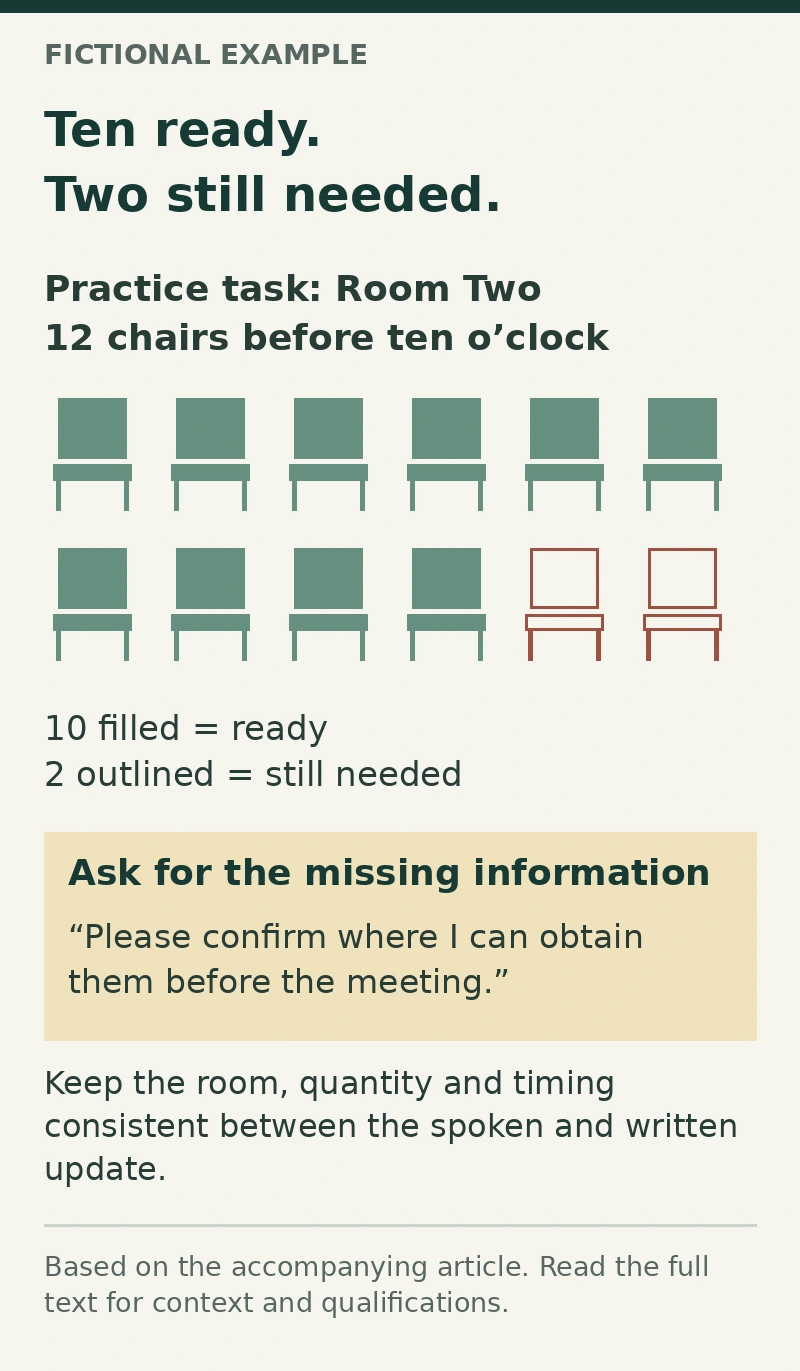
Write a brief message about the same task. Include what is complete, what has changed and what decision is needed.
An original fictional example is: “Room Two has ten chairs ready. Two additional chairs are still needed. Please confirm where I can obtain them before the meeting.”
Compare the spoken and written versions. Check that the room, quantity and timing have not changed accidentally. Practise reading numbers, dates and names carefully, because a fluent sentence can still contain the wrong detail.
Build a personal task phrase bank
Record phrases under useful actions:
- Clarify: ask which item, location or deadline applies.
- Confirm: summarise the agreed task and next step.
- Report: describe an observable change without guessing its cause.
- Ask for support: identify the step that needs explanation.
- Hand over: state what is complete and what remains outstanding.
Add the context and an example you understand. Avoid collecting expressions you cannot explain or using a script that conceals uncertainty. It is appropriate to ask someone to repeat, slow down or show a written instruction.
Review understanding with suitable support
Repeat the exercise with a tutor or trusted practice partner. Ask them to check whether the message is understandable and complete. Choose one improvement, then repeat without reading the whole script.
The Skills for Education and Employment program offers language and foundation-skills training to eligible participants. Ask a provider about current eligibility and suitable learning support; participation is not established by this article.
Keep a short record of situations you can now manage and situations that still need help. Progress can mean asking a precise question sooner, correctly confirming a changed instruction or writing an update that lets another person act.
As your practice improves, use the guide to demonstrating work skills to describe a specific communication task you can complete, rather than making an unsupported proficiency claim.