Everyday workplace calculations need more than a number from a calculator. You need to know what is being counted, which units apply and whether the result makes sense for the task.
Use the original fictional exercises below to practise a checking routine. They concern ordinary stock and time arithmetic. They are not procedures for medication, lifting, engineering, electrical work or another safety-critical calculation, where authorised methods and competent checking are essential.

Write the question before calculating
Imagine a storeroom expects twelve cartons containing eight notebooks each. The first question is how many notebooks should arrive, not how many cartons are on the delivery.
Write the units alongside the calculation: twelve cartons multiplied by eight notebooks per carton equals ninety-six notebooks. Keep the carton count and notebook count separate in the record.
If the packing information is unclear, obtain the correct information before calculating. A precise answer based on the wrong pack size is still wrong.
Estimate, calculate and compare
Make a rough estimate before entering figures. Ten cartons of eight would contain eighty notebooks, so twelve cartons should contain more than eighty. The calculated ninety-six is consistent with that estimate.
Now suppose only eleven complete cartons arrive. Eleven multiplied by eight is eighty-eight notebooks. Comparing the expected ninety-six with the received eighty-eight shows a difference of eight notebooks, equivalent to one complete carton in this fictional example.
That calculation identifies a discrepancy to check. It does not prove why the difference occurred or authorise changing a supplier’s invoice. Check the delivery record and report through the agreed process.
Be careful when converting time
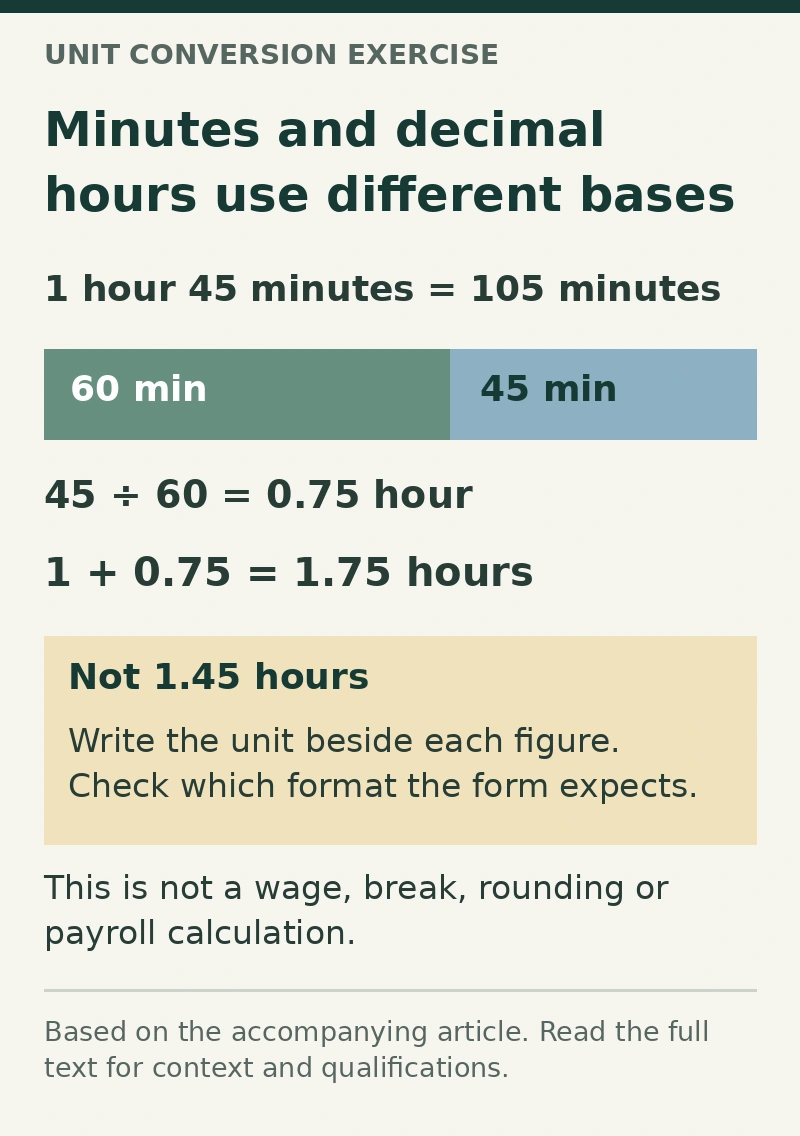
Hours and minutes do not use the same base as a decimal number. One hour and forty-five minutes is 105 minutes. As decimal hours, it is 1.75 hours, because forty-five divided by sixty is 0.75.
It is not 1.45 hours. Writing the unit beside each figure helps expose that mistake. Check whether a form expects minutes, hours and minutes, or decimal hours before entering the result.
This is a conversion exercise, not a wage calculation. Pay records can involve separate rules about paid time, breaks, rounding and applicable employment instruments.
Use a practical calculation-check record
For a practice task, write:
- Question: exactly what must be worked out.
- Inputs: figures and where they came from.
- Units: cartons, individual items, minutes or another defined measure.
- Estimate: the approximate result expected.
- Method: the operation and any conversion.
- Result: the calculated answer with its unit.
- Check: a second method, recount or authorised independent review.
- Action: who needs the result and what remains unconfirmed.
For the notebook exercise, an independent check could count the cartons again and confirm the stated pack size. Re-entering the same unchecked figures into a calculator does not check the original information.
Build confidence with appropriate practice
Practise one type of calculation until you can explain the method, then change a figure or unit. Keep examples invented and separate from live workplace records. Ask for help when the instructions, units or level of responsibility are unclear.
The Australian Government’s Skills for Education and Employment program includes maths support for eligible participants. A provider can discuss current eligibility and learning needs. The aim of practice is a reliable checking habit, including recognising when a calculation needs someone else’s expertise.
The stock-counting exercise also provides context for exploring warehouse roles and their duties; employers’ actual systems and training requirements still apply.