An interview presentation should answer the assigned question, make your reasoning easy to follow and finish within the agreed time. Start with the brief and assessment criteria, then build a short argument supported by relevant evidence. Slide design comes after the message is clear.
Confirm whether the employer wants slides, a verbal briefing, a demonstration or another format. Check the audience, time available, submission method, equipment and whether questions fall inside or outside the presentation time. Do not assume that “presentation” means a long slide deck.
Choose one main answer
Write a single sentence explaining your recommendation or finding. If the brief asks how you would improve a process, identify the problem, propose an approach and explain how you would check whether it worked. A catalogue of everything you know is harder to assess than a focused answer.
Separate facts supplied by the employer, public evidence and your own assumptions. Do not invent access to internal budgets, staffing numbers or customer data. If necessary, say what information you would obtain before making a real decision.
Business Queensland’s hiring guidance includes presentations among assessment activities employers may explain to candidates. Ask the contact person about an unclear format rather than guessing from a generic interview checklist.
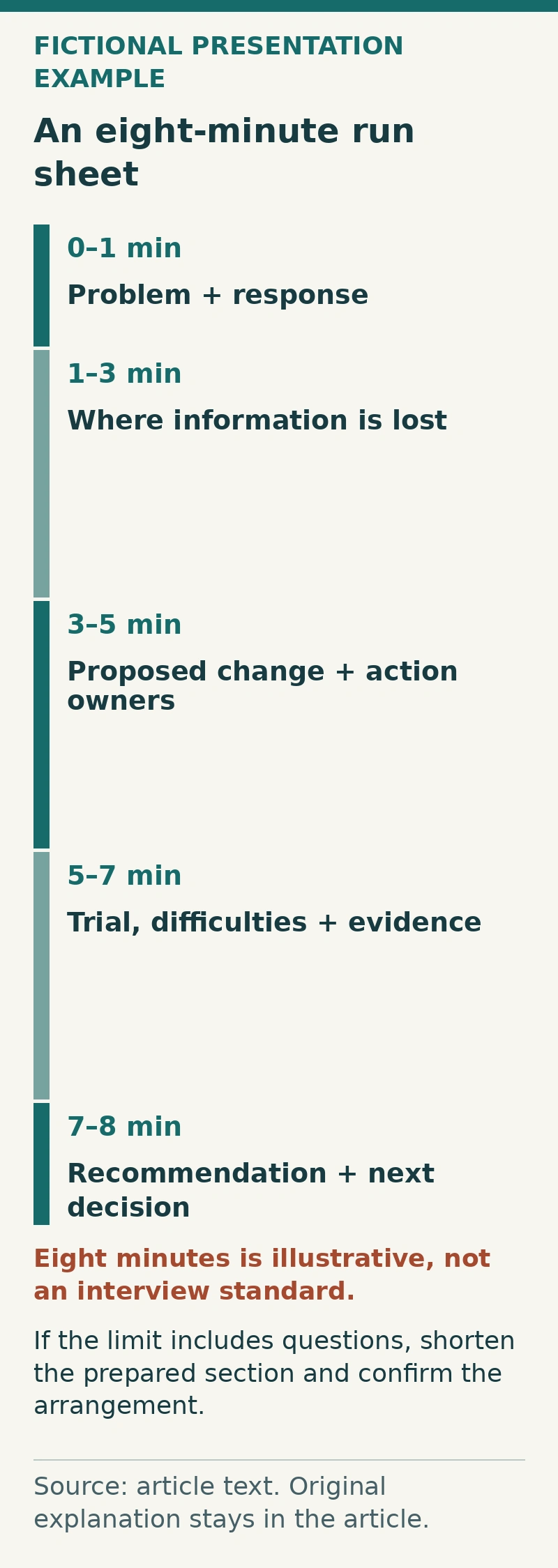
A fictional eight-minute run sheet
This original example is a practice exercise for an invented administration role. Eight minutes is an illustrative limit, not a standard recruitment requirement.
- First minute: define the fictional problem—booking changes are not reaching the next shift—and state the proposed response.
- Minutes one to three: show where information is lost, using a simple invented sequence rather than real customer records.
- Minutes three to five: explain the proposed change, who would own each action and how staff would confirm the latest version.
- Minutes five to seven: describe a small trial, possible difficulties and the evidence you would collect.
- Final minute: restate the recommendation and identify the decision or information needed next.
Questions would follow only if the employer has allocated separate time. If the full eight minutes includes questions, shorten the prepared section and confirm the arrangement.
Support the story with usable visuals
Each visual should do a job: explain a process, compare options or show evidence. Use readable text and labels that make sense without animation. A simple diagram can be more useful than a decorative photograph with a paragraph over it.
Label fictional examples clearly. Include the source and date for real statistics, and check whether the number actually supports your recommendation. Do not turn a general industry trend into proof of demand for the particular role.
Keep a permitted backup format and check that links or media work without access to your private account. If the employer supplies a platform, follow its instructions rather than introducing an unapproved application.
Rehearse the transitions and the questions
Practise aloud with a timer. Notice where you explain background twice or spend too long on one example. Rehearse the sentence that moves from the problem to your recommendation; this is often where an audience loses the thread.
Ask someone to challenge one assumption. Practise acknowledging a limit, explaining your reasoning and describing what you would verify. An honest “I would need to check the approval process” is more credible than inventing an answer.
Complete a final readiness check
Confirm the final version, recipient, filename and delivery arrangements. Check whether the employer requires advance submission and whether changes after that point are allowed. Arrange any accessibility discussion early enough to resolve the practical format.
Use our general interview guide for the wider conversation. Your presentation has a narrower purpose: give the panel a clear, supportable answer to the task it actually set.