


A backup is useful only if the required information can be recovered in a usable form. An authorised restore test checks that outcome under controlled conditions, with evidence about what was restored and any gap needing attention.
Plan the test with the responsible system and information owners. Do not restore over live work, expose sensitive data or change a production system as an improvised experiment.

Define the recovery question
Identify what the test needs to demonstrate: recovering a permitted file set, opening a document or restoring another defined business resource. Agree the approved environment, information handling and person responsible for technical actions.
Australian cyber-security guidance on protecting devices, systems and networks discusses backups as part of business recovery. The actual backup and testing method should suit the business’s requirements and authorised systems.
Distinguish a backup job reporting success from a verified restore. They are related checks, but one does not establish the other.
Use a restore-test brief
Record:
- Purpose: the recovery capability being checked.
- Scope: approved information, backup point and exclusions.
- Environment: authorised non-production destination and access.
- Roles: technical operator, information reviewer and decision owner.
- Expected result: files, versions or other evidence needed for success.
- Protection: handling, retention and cleanup requirements for restored material.
- Evidence: observations, timing and exceptions to record.
- Outcome: accepted result, corrective action or further test required.
Avoid including credentials or sensitive backup locations in a broadly shared checklist. Use the approved restricted record for operational details.
A fictional five-file exercise
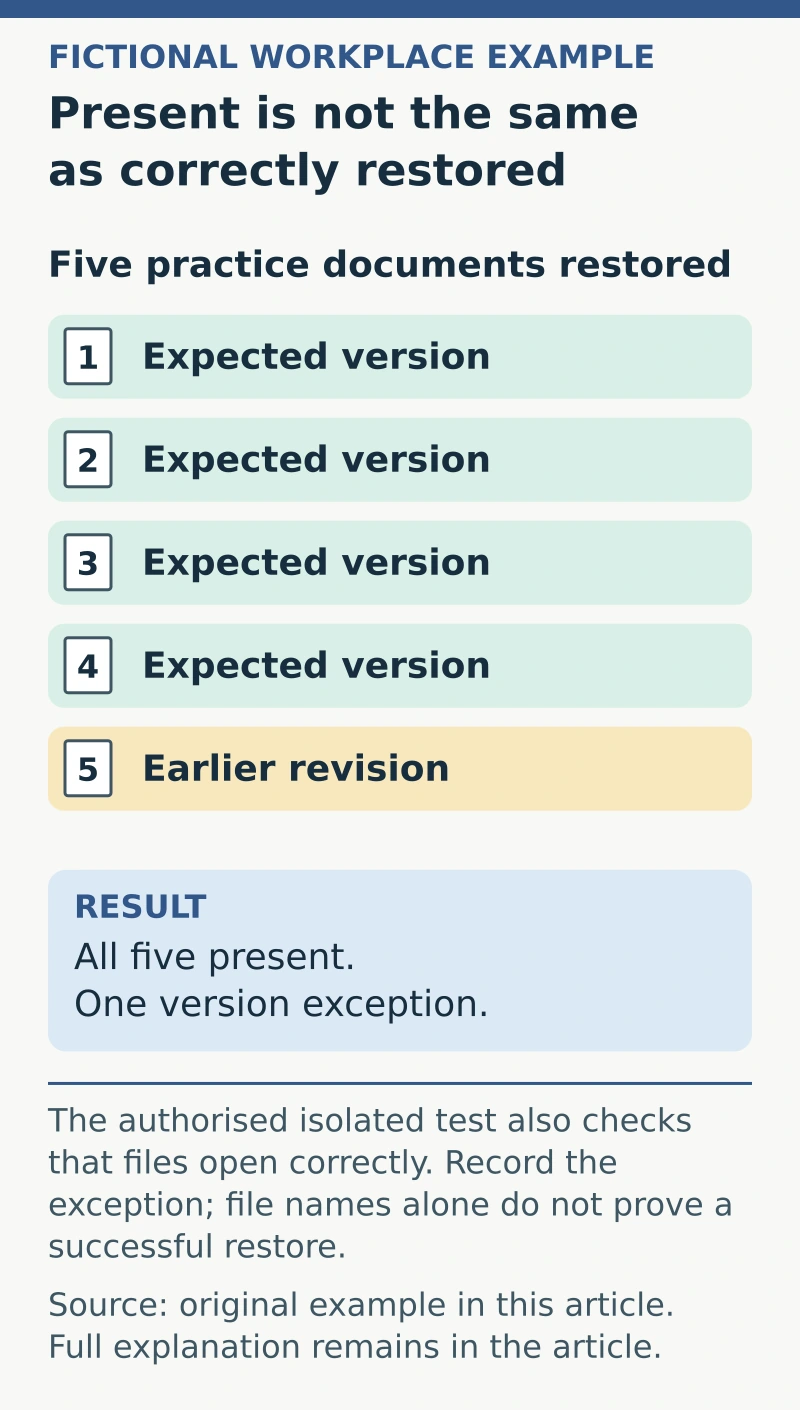
In this invented example, a system owner authorises a test using five non-sensitive practice documents. The expected versions are recorded before the test, and an approved isolated location is used.
After restoration, the reviewer checks that all five documents are present, open correctly and match the expected versions. One file opens but contains an earlier revision than expected. The test records that exception rather than claiming success because five file names appeared.
The example does not demonstrate recovery of every business system or prove that a real outage would have no impact.
Investigate the gap through the right owner
Check whether the test expectation, backup selection, schedule or another factor explains the result. Separate a confirmed finding from a hypothesis and obtain the appropriate technical review.
Assign corrective work and another verification point where needed. Do not mark an issue resolved merely because a configuration change has been requested.
If testing reveals an actual incident or data exposure, follow the relevant response process promptly rather than leaving it in the routine test report.
Review evidence and clean up appropriately
Have the authorised owner assess whether the defined recovery objective was met. Retain the necessary evidence and handle restored test material through the approved cleanup and records process.
Repeat or broaden testing when justified by changes or unresolved findings, using an appropriate plan. A useful restore test gives the business evidence about a defined recovery capability and its limits, with clear ownership of anything that still needs work.
If backup and recovery work interests you professionally, compare the responsibilities in the IT career roles guide before choosing further training.