

A civil engineering technician supports civil engineering work through technical information, records and tasks allocated within their competence. Assess a vacancy by the actual design-support, field, laboratory or construction responsibilities it includes.
The role needs a clear relationship with the responsible professionals. A technician title or qualification does not automatically confer authority to provide independent professional engineering services.

Understand the support scope
The ABS civil-engineering technician description includes technical preparation, construction-materials work and support for engineering professionals. Actual roles may emphasise different parts of that scope.
Read the advertisement for qualifications, technical experience, software, site requirements and supervision. Ask who defines the task, checks the output and makes the professional decision.
Queensland’s professional engineering regulator explains requirements for professional engineering services, including relevant registration and exceptions. Verify how those rules apply to the actual work; do not assume an informal review automatically satisfies the required arrangement.
Keep technical records identifiable
Check the project reference, version, units, source and purpose of information before preparing a table, sketch or other output. Preserve uncertainty rather than making an undocumented correction.
If a measurement or result appears inconsistent, follow the approved review route. This career guide does not provide a field-testing, design, inspection or construction procedure.
The existing construction roles guide provides broader context, while the actual technical vacancy determines the evidence required.
A fictional units exercise
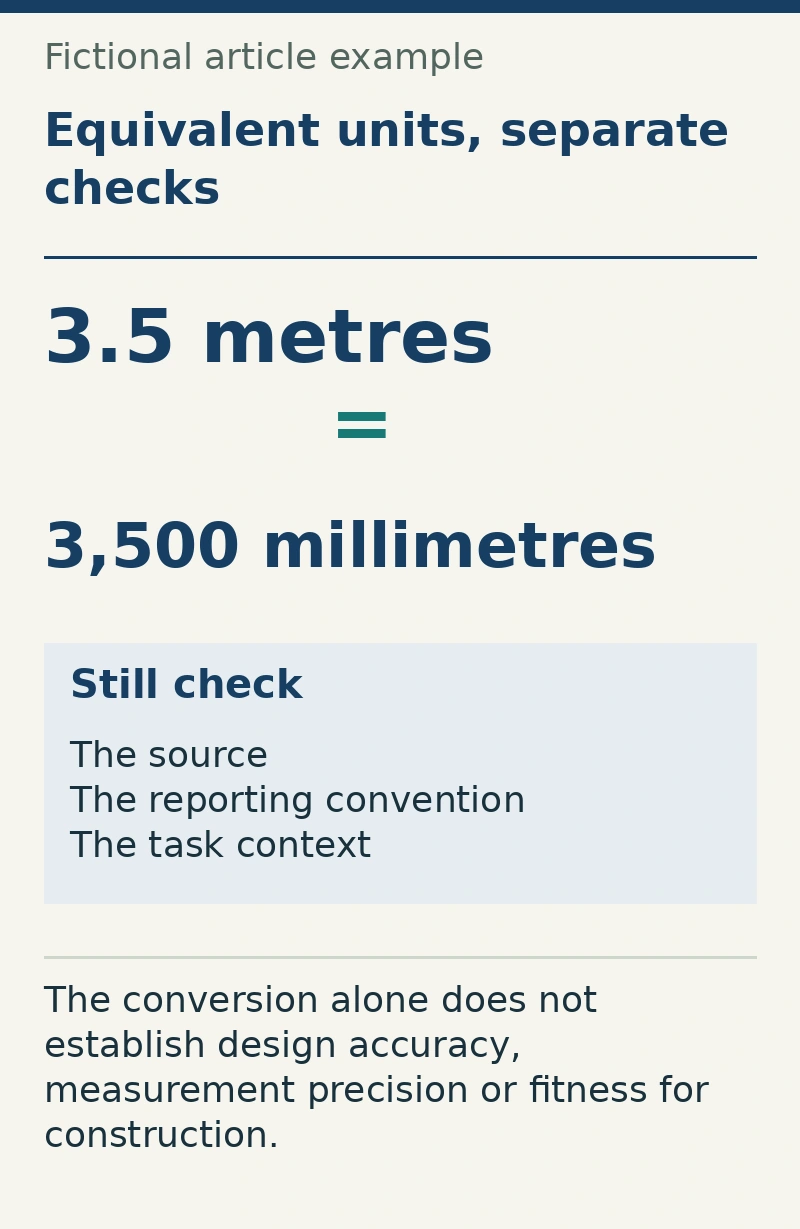
In this invented practice task, two source records describe a dimension using 3.5 metres and 3,500 millimetres. Those quantities are mathematically equivalent, but the technician still checks the source, required reporting convention and context before combining records.
They identify which document and units belong to the task and refer any remaining ambiguity to the responsible reviewer. They do not infer design accuracy, measurement precision or fitness for construction from the conversion alone.
No actual engineering measurement or decision is claimed by the exercise.
Build a technical-support evidence brief
For a permitted or fictional example, describe:
- Context: technical task and your responsibility.
- Inputs: source, version, units and relevant requirements.
- Method: support work you personally performed within competence.
- Checks: consistency, traceability and review undertaken.
- Question: uncertainty or discrepancy raised.
- Supervision: competent reviewer and approval process.
- Output: supported result and information you may disclose.
Keep client drawings, site information and technical data protected. Do not claim another professional’s design or certification as your own work.
Clarify learning and review support
Ask how new technicians learn the employer’s methods and how unfamiliar tasks are assigned and checked. Verify any proposed qualification or recognition pathway with the relevant provider or authority.
Match your application to the actual task mix. A strong technician example explains reliable technical support, accurate records and appropriate escalation, helping the employer understand both your contribution and the professional review arrangement that supported it.