


Supplier quotes are comparable only when they cover the same requirement and their differences are visible. Start with the approved specification, then identify scope, exclusions, timing and total charges before making a recommendation.
A lower headline price does not establish the better offer. Nor does completing a comparison give the preparer authority to accept terms or place an order.

Establish a common requirement
Describe the item or service, quantity, delivery location, required timing and relevant acceptance criteria. Check that each supplier has responded to the same current version. If you are a business preparing to supply services, our local business opportunities guide can help frame the wider supplier context; the comparison must still use this buyer’s actual requirement and current quotes.
The Australian Government’s supplier guidance discusses considering factors such as price, quality, reliability and terms. Use the business’s actual purchasing criteria and verify relevant information rather than treating an example checklist as a universal supplier score.
Where a quote answers a different requirement, obtain clarification or record the limitation. Do not quietly add an assumed service to make the comparison fit.
Use a practical comparison record
For each quote, check:
- Scope: included items, services and quantities.
- Exclusions: work or costs not covered.
- Charges: currency, applicable taxes and additional amounts to verify.
- Timing: availability, delivery or completion basis.
- Conditions: validity period, payment terms and other relevant commitments.
- Quality evidence: support for the required capability or specification.
- Uncertainty: assumptions and clarification still needed.
- Decision: approved evaluation and purchasing authority.
Keep sensitive commercial information restricted and use the approved process for supplier enquiries and clarifications.
A fictional price comparison
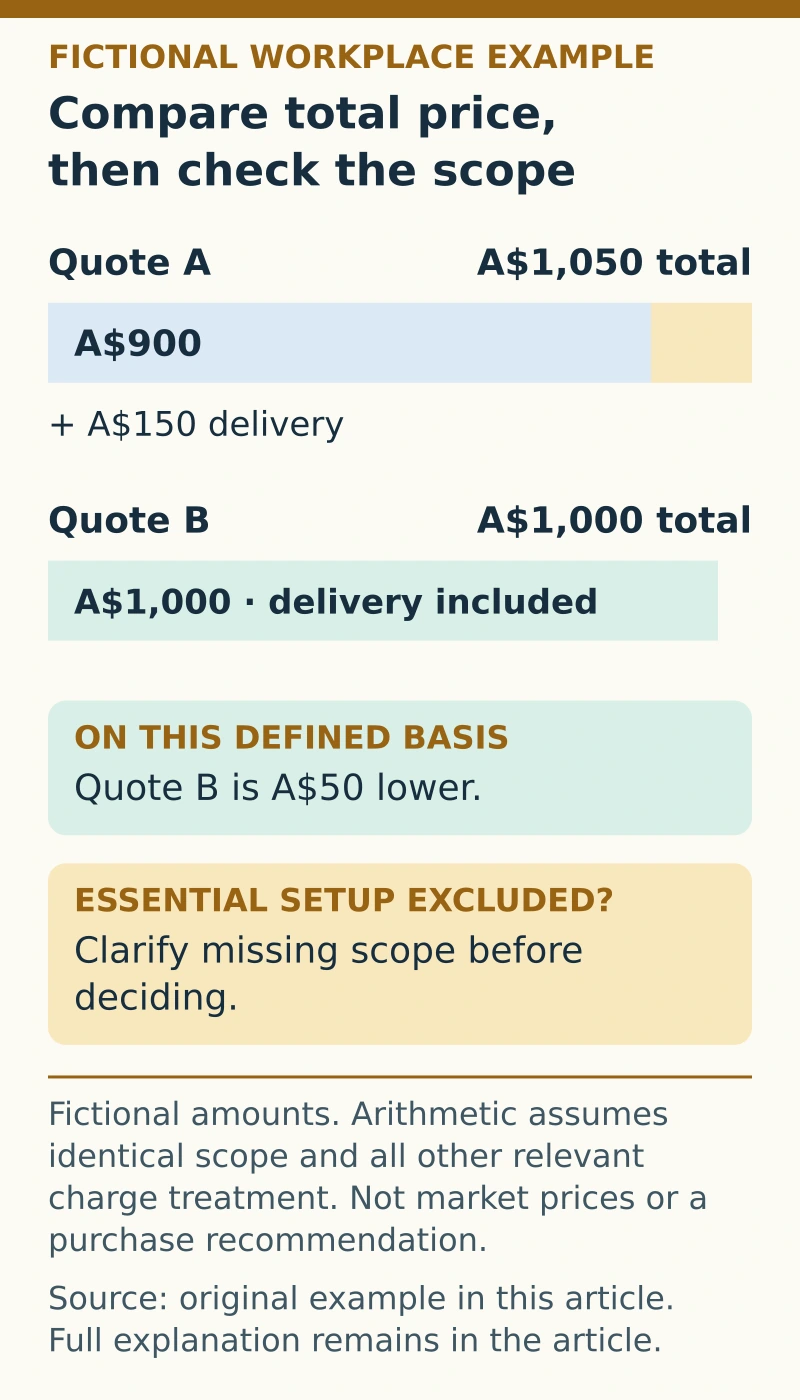
In this invented example, Quote A is A$900 plus A$150 delivery. Quote B is A$1,000 including delivery. Assume only for the arithmetic that the scope and all other relevant charge treatment are identical.
The comparable totals are A$1,050 and A$1,000. Quote B is A$50 lower on that defined basis. These are fictional amounts, not market prices or a recommendation for a real purchase.
If Quote B excludes an essential setup activity, the earlier conclusion is incomplete. The missing scope needs clarification and assessment before a decision.
Record trade-offs instead of hiding them
If one supplier offers a different delivery date or service level, describe the operational effect. Ask the relevant owner to verify whether the difference is acceptable.
Avoid an elaborate weighted score unless the criteria, weightings and evidence have been appropriately agreed. A precise total can hide subjective assumptions or a mandatory requirement that should not be traded away for a lower price.
Check any licence, accreditation, insurance or other requirement relevant to the actual work through the appropriate source. Do not add a generic list of certificates that may have no bearing on the engagement.
Make the recommendation reviewable
Summarise the common basis, material differences, verified information and remaining questions. Identify the decision requested and any conditions to satisfy before commitment.
Record the authorised outcome and carry it into the purchase process. If the quote changes or expires, review the effect rather than assuming the earlier approval covers the new terms. A useful comparison leaves the reviewer able to understand why an option was recommended and what information supports that conclusion.