A team action tracker keeps commitments visible between meetings. It should show what needs to happen, who owns it, what is blocking progress and what evidence will establish completion.
Begin with a manageable list of real actions. Do not turn every topic discussed into an action or mark work complete because someone has sent an email about it.

Write an action as an observable result
Use a verb and a defined output. “Booking instructions” is a topic. “Revise the cancellation instructions and submit version 0.4 for review” is an action someone can complete and another person can check. Action tracking is a useful coordination skill to demonstrate when applying for the work described in our administration jobs guide; use an anonymised or fictional example that shows ownership and verified completion.
Separate preparation from approval where different people hold those responsibilities. The person drafting a document may complete their action while the approval decision remains open in a separate entry.
The Queensland Transport and Main Roads project-management framework provides context for structured management of project work. The tracker below is an original general coordination method, not an official template or delegated authority.
Use a practical action-record structure
For each entry, include:
- Identifier: a stable reference that remains recognisable across updates.
- Action: the specific result required.
- Owner: one accountable contact, with contributors identified separately.
- Due point: the agreed date or dependency that determines timing.
- Status: not started, in progress, blocked or complete, using clear definitions.
- Dependency: the information or decision needed from someone else.
- Completion evidence: a link or reference to the verified output.
- Source: the meeting or authorised instruction that created the action.
Do not put confidential case details into a general tracker. Reference the approved restricted record when appropriate.
A fictional action through its lifecycle
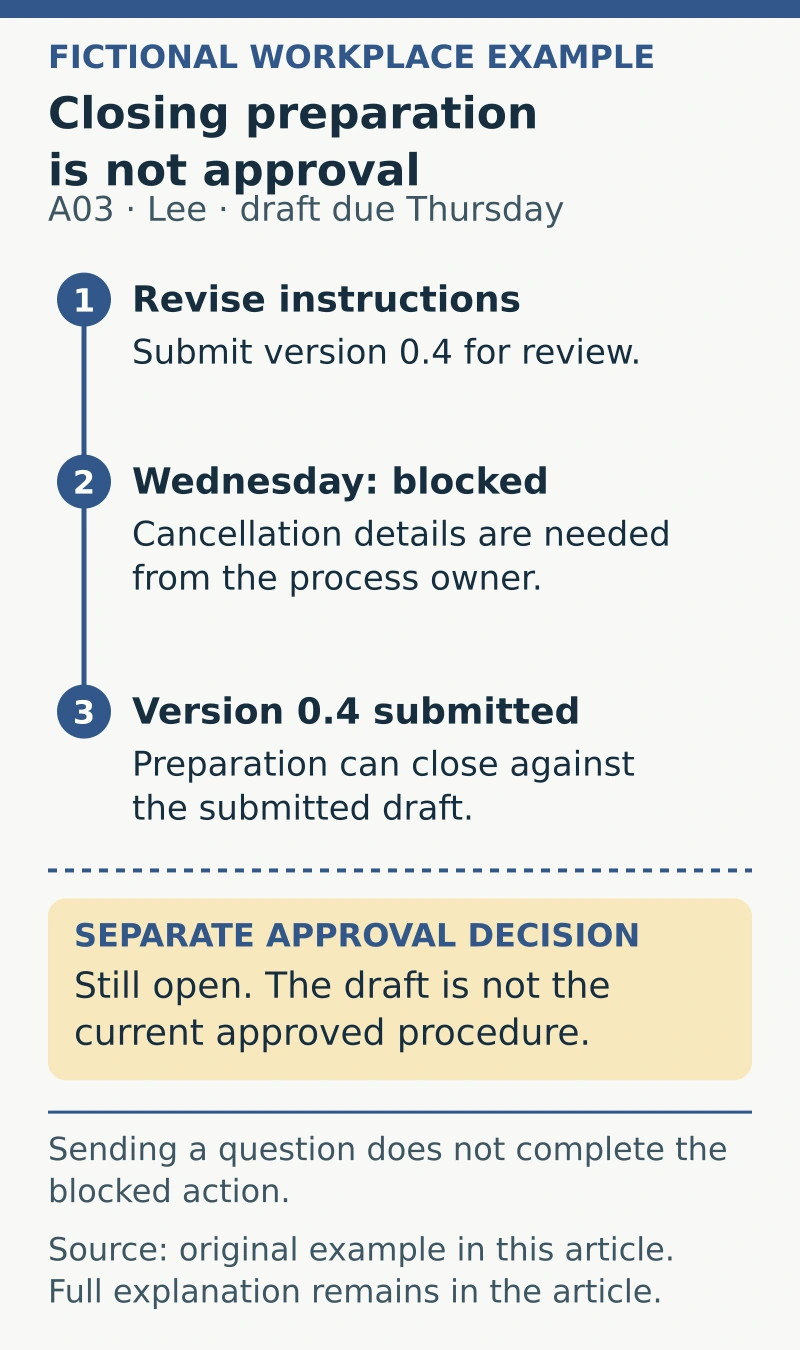
In this invented example, action A03 requires Lee to revise the booking instructions and submit a draft for review by Thursday. On Wednesday, Lee records that the cancellation section is awaiting information from the process owner.
The action becomes “blocked”, with the missing information and contact identified. It is not marked complete because the question has been sent. The coordinator checks the effect on timing and escalates through the agreed process if needed.
Once version 0.4 is submitted, the preparation action can close against that evidence. Approval remains a separate decision; the draft is not labelled as the current approved procedure.
Review overdue work without hiding history
Ask whether the scope, resources or dependency changed. Record a revised due date and reason where authorised, keeping enough history to understand the change.
Avoid moving every overdue date forward simply to produce a green report. That removes the information needed to see a recurring capacity or decision problem.
Where an action is no longer needed, record its cancellation and who authorised that outcome. “Cancelled” and “completed” answer different questions.
Close actions against evidence
At review, check whether the output meets the agreed definition and whether a required recipient has received it. If further approval is needed, identify the next action rather than assuming closure of one entry completes the whole process.
Archive or filter closed items so current work remains usable, retaining records through the approved process. A reliable tracker gives a clear answer to “what happens next?” and allows another person to verify why an action was closed.