




Coordinate off-the-job apprenticeship training with the employer and supervising RTO before the dates arrive. Confirm attendance, release from work, payroll treatment, travel and any required records. Training should be part of the employment-and-learning arrangement rather than an unexplained clash with the roster.
The detailed pay and cost rules depend on the applicable award or agreement and arrangement. Check them directly; do not assume every training activity, travel period or school-based schedule is treated identically.

Match the plan with the training dates
Use the current training plan and the RTO’s confirmed schedule. Identify classroom, block, online or other structured training and ask what attendance and assessment requirements apply. Keep the qualification being pursued distinct from any additional workplace requirements; our job qualifications guide provides context for checking those different forms of evidence.
Queensland’s training-problems guidance identifies release for training and paid training among the matters apprentices and trainees can seek help with. Raise a roster conflict promptly with the employer and training organisation rather than simply missing either work or training.
Keep provisional dates marked as provisional. If the RTO changes a session, ask who will update the roster and payroll instructions.
Check pay and training costs separately
Fair Work’s apprentice-entitlements guidance explains that trade-school time for apprentices is paid and included in ordinary hours. School-based arrangements use different calculation rules. Check the actual employment and award or agreement requirements rather than extending one timetable example to every learner.
Course fees, prescribed materials, travel and accommodation may involve separate rules or support programs. Fair Work’s training-cost guidance explains why fee entitlements vary between awards. Do not assume payment of training time settles every expense question.
Ask which records payroll needs and how an absence from ordinary workplace duties should be entered. Avoid recording training as an unexplained no-show or automatically using personal leave to solve a scheduling problem.
A practical training-attendance worksheet
For each confirmed period, record:
- RTO session: dates, location or approved online arrangement.
- Plan reference: relevant training or assessment requirement.
- Work release: employer contact and the confirmed arrangement.
- Payroll: applicable treatment and evidence or timesheet entry required.
- Travel and costs: entitlement or support questions checked separately.
- Attendance record: how completion or a changed session is confirmed.
- Change contact: who must be told if the session or work roster changes.
Keep private student and employment information in the appropriate systems. The worksheet is a coordination aid, not a substitute for the training plan or official attendance record.
A fictional roster-conflict example
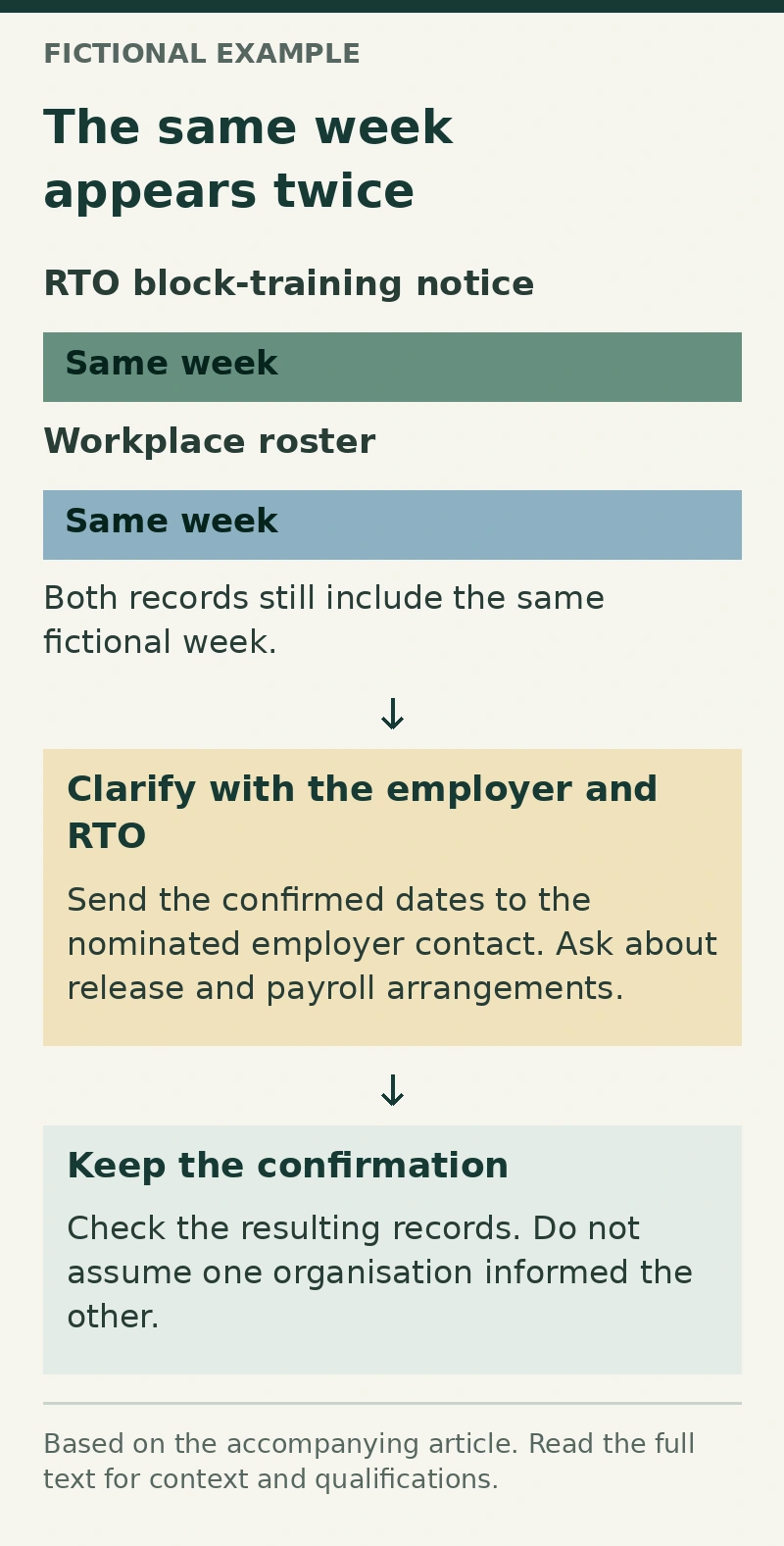
This original scenario is invented. Alex receives an RTO block-training notice for a week that still appears on the workplace roster. Alex sends the confirmed dates to the nominated employer contact and asks for the release and payroll arrangement to be clarified.
The employer and RTO resolve the schedule through the appropriate process. Alex keeps the confirmation and checks the resulting records, instead of assuming either organisation has automatically informed the other.
Follow up the actual attendance and payment
Keep the attendance evidence, authorised schedule changes and relevant payslip. Ask a focused question if the hours or training record do not match what occurred.
If release or training support remains unresolved, contact your Apprentice Connect Australia Provider or the relevant Queensland apprenticeship-support service. Use current official guidance for the actual issue without assuming a course-booking receipt establishes every employment entitlement.