








A busy shift rarely ends with every task completed. There may be customer requests waiting for a response, records that need updating or work that another team must finish. When the next person arrives, they should not have to piece together what happened or ask several people for missing details.
A shift handover template makes it easier to pass on important information. It shows what has been completed, what remains outstanding, what needs attention first and who is responsible for the next action.
Whether you work in administration, hospitality, customer service or operations, a clear handover helps the next person continue the work without unnecessary confusion.
Start With the Basic Shift Details
Before listing unfinished tasks, identify the shift and the people involved. A shift handover template should include these details so the incoming employee understands which records and updates they are receiving.
Include:
Date of the handover
Outgoing and incoming shift times
Department, location or work area
Name or role of the outgoing employee
Name or role of the incoming employee
Date and time the handover was prepared
Always make the time clear. An update written at 3 pm may no longer reflect the situation at 6 pm, especially when several changes have occurred during the shift.

How to Use a Shift Handover Template
The most useful part of a handover is the information the next person needs to act on.
Avoid writing a long account of everything that happened. Focus on unfinished tasks, important changes and decisions that are still required.
For each item, record:
Task or issue: What needs attention?
Current status: Is it complete, in progress, waiting or unverified?
Next action: What should happen next?
Responsible person: Who will handle it?
Deadline: When does it need attention?
Supporting record: Where can the incoming person find more information?
Use clear descriptions instead of vague updates such as “still pending” or “please follow up.”
For example, “Customer refund pending” does not explain what remains to be done. A better note would identify whether the request has been checked, whether approval is outstanding and which person or role needs to take the next step.
Make Important Tasks Easy to Prioritise
Not every unfinished task needs the same level of attention. If the handover contains several items, help the incoming person identify which ones matter first.
You can organise them into three practical groups:
Immediate attention
Items that require prompt action or escalation under the workplace process.
Due during the incoming shift
Tasks with a specific deadline, appointment or expected response time.
Routine follow-up
Outstanding work that can be handled after higher-priority responsibilities.
Do not label something urgent simply because it is unfinished. Explain the reason for the priority, such as a confirmed deadline, a customer waiting for an update or a decision needed before work can continue.
For safety-related or urgent matters, follow the workplace reporting and escalation process immediately. A written handover should support that process, not delay it.
A Simple Shift Handover Template You Can Follow
A consistent format makes handovers easier to prepare and review. You can adapt this example to your workplace’s approved system.
| Handover detail | Information to record |
|---|---|
| Date and time | Date and time the handover was prepared |
| Work area | Department, location or assigned area |
| Outgoing employee | Name or role |
| Incoming employee | Name or role |
| Completed work | Important tasks finished during the shift |
| Outstanding work | Tasks that still need attention |
| Priority | Immediate, due this shift or routine follow-up |
| Next action | Specific action required |
| Responsible person | Person or role assigned to follow up |
| Deadline | Expected completion or response time |
| Supporting record | Approved file, log, reference number or system |
| Handover confirmation | Confirmation that the information was received |
For a shorter handover, use this format for each outstanding task:
Task or issue:
Current status:
Next action:
Person responsible:
Deadline:
Supporting record:
Additional information:
The goal is not to fill every field unnecessarily. Include the details that help the next person understand and continue the work.
Show What Is Known and What Still Needs Checking
A handover should distinguish confirmed information from assumptions.
For example, if a delivery has not arrived, do not write that it has been cancelled unless someone has confirmed the cancellation. State what you know, what you have checked and what remains unresolved.
A useful update might read:
“The scheduled delivery has not arrived as of 3:30 pm. The supplier was contacted at 3:15 pm, and a revised arrival time has not yet been confirmed. The incoming coordinator should check for an update before arranging an alternative.”
This gives the next person a clear starting point without presenting an assumption as a fact.
The same approach applies to customer requests, equipment issues, bookings and administrative tasks. If a decision is still waiting for approval, identify the person or role responsible for making it. Do not imply that an option has been approved when it has not.
Example: A Clear Handover for an Outstanding Request
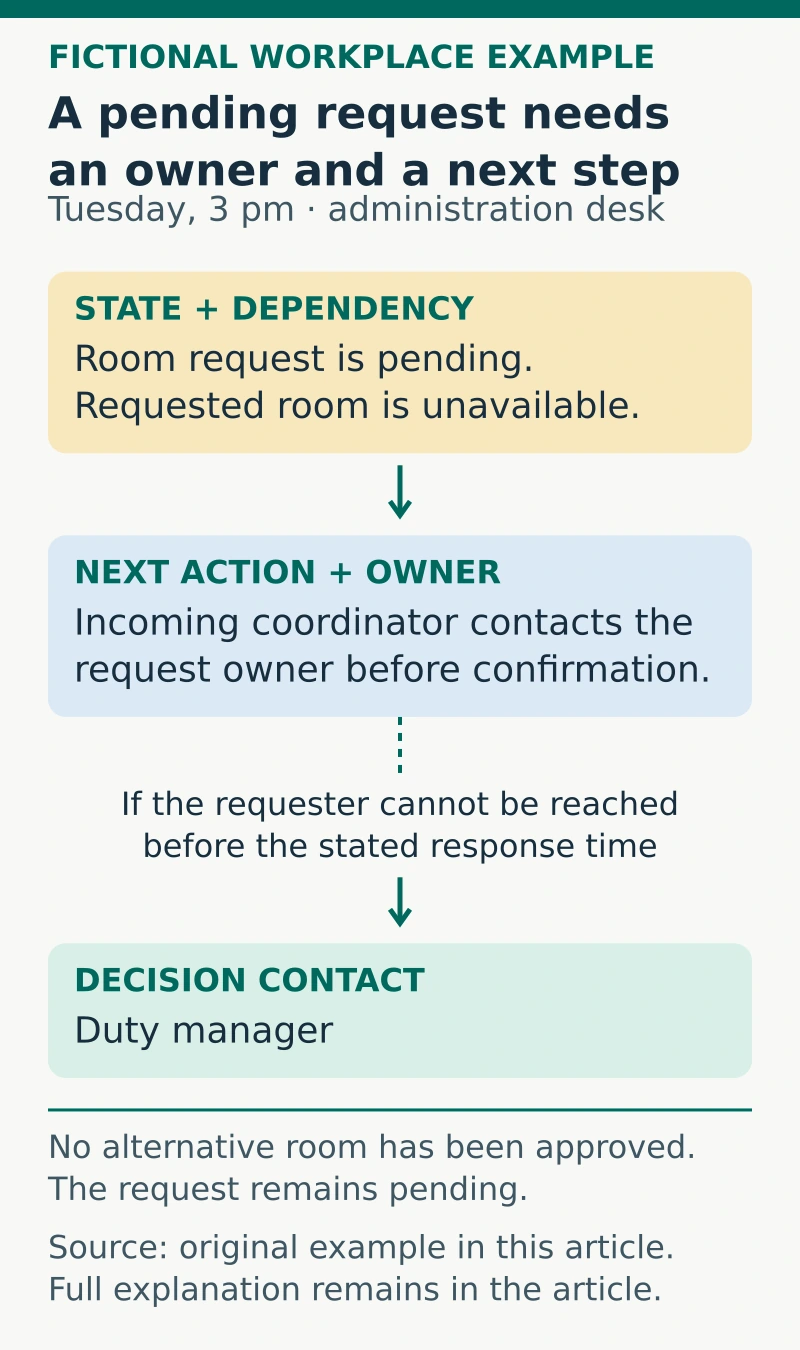
Imagine an administration coordinator is finishing a shift with an unresolved room booking.
A vague handover might say:
“Room booking still pending. Please follow up.”
That leaves the incoming coordinator with several questions. Which booking? What is the problem? Has anyone contacted the requester? What needs to happen next?
A more useful entry would be:
Task: Room booking request R12
Current status: The requested room is unavailable. No alternative has been approved.
Action already taken: The booking summary has been saved in the approved folder.
Next action: Contact the requester to discuss available alternatives.
Responsible person: Incoming administration coordinator.
Deadline: Provide an update before 4 pm.
Supporting record: Booking reference R12 in the approved booking system.
Decision contact: Duty manager if an alternative requires approval.
This example shows how a shift handover template can communicate what happened, what remains unresolved and where to find the supporting information. It also makes the limits of their responsibility clear.
Confirm That the Incoming Person Understands the Handover
Sending a message or completing a form does not always mean the next person has understood the information.
When the workplace process includes a verbal handover, briefly review the most important outstanding items together.
Ask whether the incoming person can:
Identify the tasks that need attention first.
Locate the relevant records.
Explain the next action for each important item.
Identify who can approve a decision or provide support.
Confirm any deadlines that must be met.
If a record cannot be accessed or an approval is missing, identify the appropriate person who can resolve the problem.
For further guidance on clear communication and cooperation between employees, read the Fair Work Ombudsman’s guide to consultation and cooperation in the workplace.
Keep Records Clear and Protect Private Information
A shift handover may contain customer details, employee information, operational records or other information that should not be shared widely. Use the workplace’s approved system and follow its record-keeping and privacy requirements.
Keep these points in mind:
Include only information needed for the next person to perform the work.
Use approved reference numbers instead of copying unnecessary personal details.
Store supporting documents in the correct location.
Make sure the incoming person has appropriate access.
Do not include passwords or login credentials in handover notes.
Avoid personal comments, blame or unsupported conclusions.
For example, the incoming employee may need to know that a customer request is awaiting a response. They may not need the customer’s full personal details in a general shift summary.
A handover should make work easier to continue without exposing information unnecessarily.
Update Ongoing Tasks Instead of Repeating Old Notes
Some tasks remain open for several shifts. When this happens, update the latest status rather than copying the same unfinished item into every new handover without explanation.
Record what has changed, what action has been completed and what still needs attention.
If an item has been referred to another department, include the referral details and any expected follow-up. Do not mark it as completed until the required outcome has actually been confirmed.
Repeated delays can also reveal a problem with task ownership, access or workplace procedures. If the same issue keeps appearing in handovers, raise it with the appropriate supervisor rather than allowing it to continue without review.
For wider context about shift arrangements, briefings and workplace responsibilities, read our guide to a typical major-event workday.
Before You Finish Your Shift, Check These Details
Take a final moment to review your handover before signing off.
Have you included the correct date, time and work area?
Are completed and unfinished tasks clearly separated?
Have you identified the most important priorities?
Does every outstanding task have a clear next action?
Have you identified the responsible person or role?
Are deadlines and supporting records easy to find?
Have you separated confirmed facts from unresolved information?
Have you followed the workplace process for urgent matters?
Can the incoming person access the records they need?
A clear shift handover template does not need to be complicated. It needs to contain the right information, written in a way that another person can understand and act on. When the next shift can identify what needs attention, where to find the relevant information and who is responsible for the next step, the handover has done its job.