

A simple project risk register records uncertain events that could affect the work and the response planned for them. Begin with a defined project objective so each entry explains what might happen and why it matters.
This guide uses an original low-risk office example. It does not replace a required safety risk assessment, specialist analysis or the organisation’s approved risk-management framework.

Describe an uncertainty, not just a topic
“Supplier” is a subject, not a useful risk statement. A more informative entry says that a printing delivery might arrive after the planned distribution date, affecting the project’s ability to provide the approved materials on time.
Separate the possible event from its cause and consequence. That helps the team decide what information or action could change the likelihood or reduce the impact.
The Australian Government’s risk-management planning guidance discusses identifying, analysing, evaluating and managing business risks. Apply the actual organisation’s criteria rather than inventing a numerical score with no agreed meaning.
Use a practical register entry
Record: A fictional entry can also support a skills example: use our practical workplace skills guide to connect the uncertainty, your proposed response and the review step without claiming responsibility for an actual project you did not manage.
- Objective: the result the uncertainty could affect.
- Risk: possible event, relevant cause and consequence.
- Existing measures: what is already in place and its evidence.
- Assessment: likelihood and impact using the approved criteria.
- Response: an action intended to manage the risk.
- Owner: the person accountable for monitoring and response.
- Trigger: information or an event requiring review or escalation.
- Review: the next check and current status.
Identify the person authorised to accept a remaining risk or approve a response. The person maintaining the spreadsheet may not hold that authority.
A fictional office-project example
An invented project needs printed instructions for an internal workshop. The risk is that the confirmed printing arrangement may not meet the distribution date if final approval is delayed.
The response is to confirm the latest approval point with the responsible manager and obtain information about an approved alternative format. The project coordinator monitors those actions; any change to the distribution approach needs the appropriate decision.
The register does not mark the risk eliminated because an enquiry email was sent. It records what has actually been confirmed and what uncertainty remains.
Keep risks and issues connected
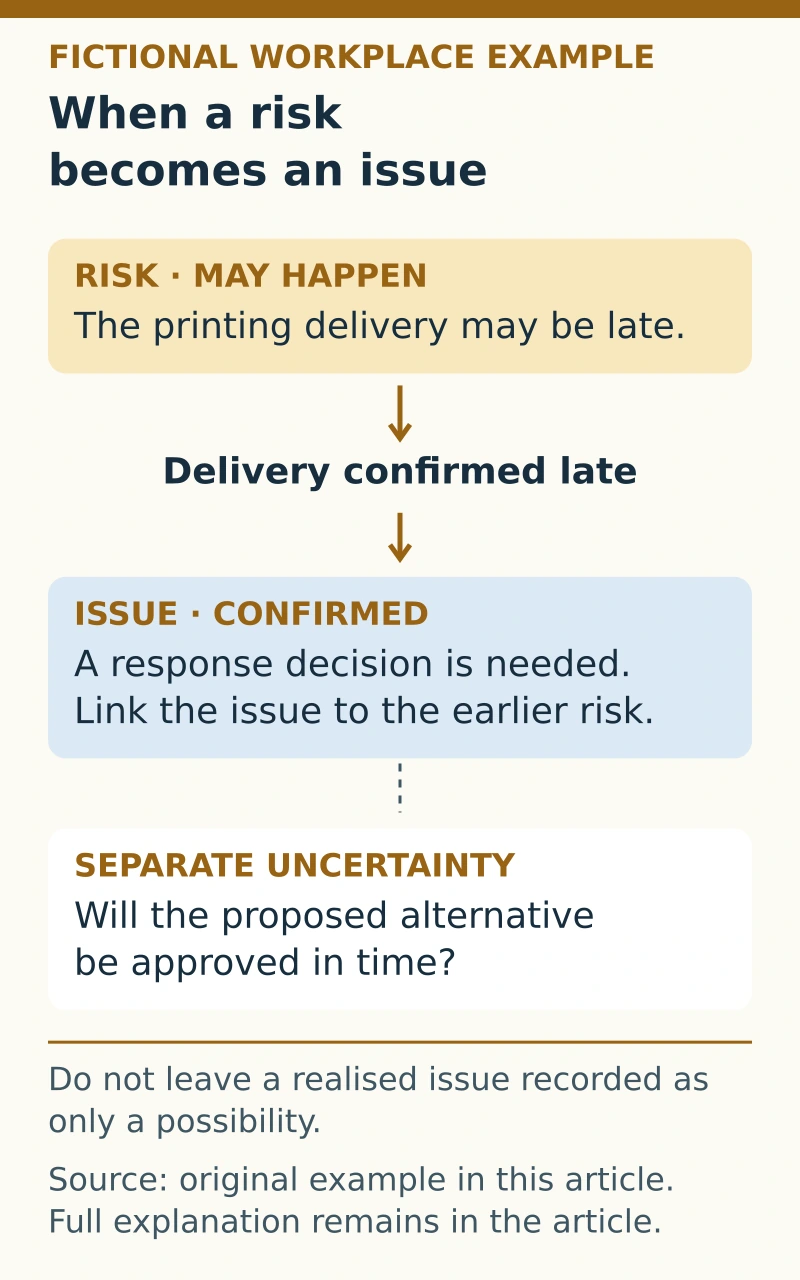
If the delivery is actually confirmed late, the realised problem needs an issue and response decision. Link that issue to the earlier risk rather than leaving the register to imply it is still only a possibility.
Other uncertainty can remain after the issue occurs, such as whether the proposed alternative will be approved in time. Review that separately rather than copying the same entry into several logs without explanation.
Use clear review triggers. For example, a missed supplier confirmation date may require earlier escalation than the routine project meeting.
Review measures and ownership
Ask whether each response has been implemented and whether it addresses the stated uncertainty. Check for changed assumptions, new information and risks that no longer apply.
Close an entry only through the approved process, recording why it is no longer relevant or how responsibility has transferred. Keep sensitive commercial information appropriately restricted. A useful risk register supports a timely decision about uncertainty; it should not become a list of worries with no owner or response.