A job description defines the work a business needs done: its purpose, responsibilities, decision limits, reporting relationships and essential requirements. Write it before the public advertisement so the manager, recruiter and new employee are working from the same role definition.
The business.gov.au hiring guide recommends preparing a role description and selection criteria as part of recruitment. The template below is an editorial planning tool, not a contract or a legal classification decision.

Begin with the work, not the previous job title
Ask what problem the position should solve and which outputs the employee will own. A departing employee may have collected unrelated tasks over time; copying their old list can preserve responsibilities that no longer make sense.
Describe actions and boundaries. “Maintain the booking register and escalate conflicting requests” is more useful than “provide administrative excellence”. Identify who approves exceptions and who checks completed work.
If the role covers several sites or changing shifts, record those facts clearly. Distinguish requirements that exist now from possible future duties. Do not turn an uncertain business forecast into a permanent promise about workload or career progression.
A blank job-description template
| Field | Information to agree |
|---|---|
| Role and version | Title, date, owner and approving manager |
| Purpose | Why the position exists and whom it supports |
| Reporting line | Direct manager and key working relationships |
| Core responsibilities | Main tasks and expected outputs |
| Authority | Decisions allowed and approvals needed |
| Work context | Location, travel, hours or roster requirements to confirm |
| Essential requirements | Job-related skills, licences or qualifications with reasons |
| Preferred evidence | Useful experience that is not an automatic exclusion |
| Support | Induction, supervision, tools and training owner |
| Review | How changes and early performance expectations are reviewed |
Complete the fields with the manager responsible for the work. Where a detail is unresolved, keep it visible as a question rather than presenting it as agreed.
A fictional completed extract
Role purpose: An Operations Support Assistant maintains the team’s request register so supervisors can see outstanding actions and approved changes.
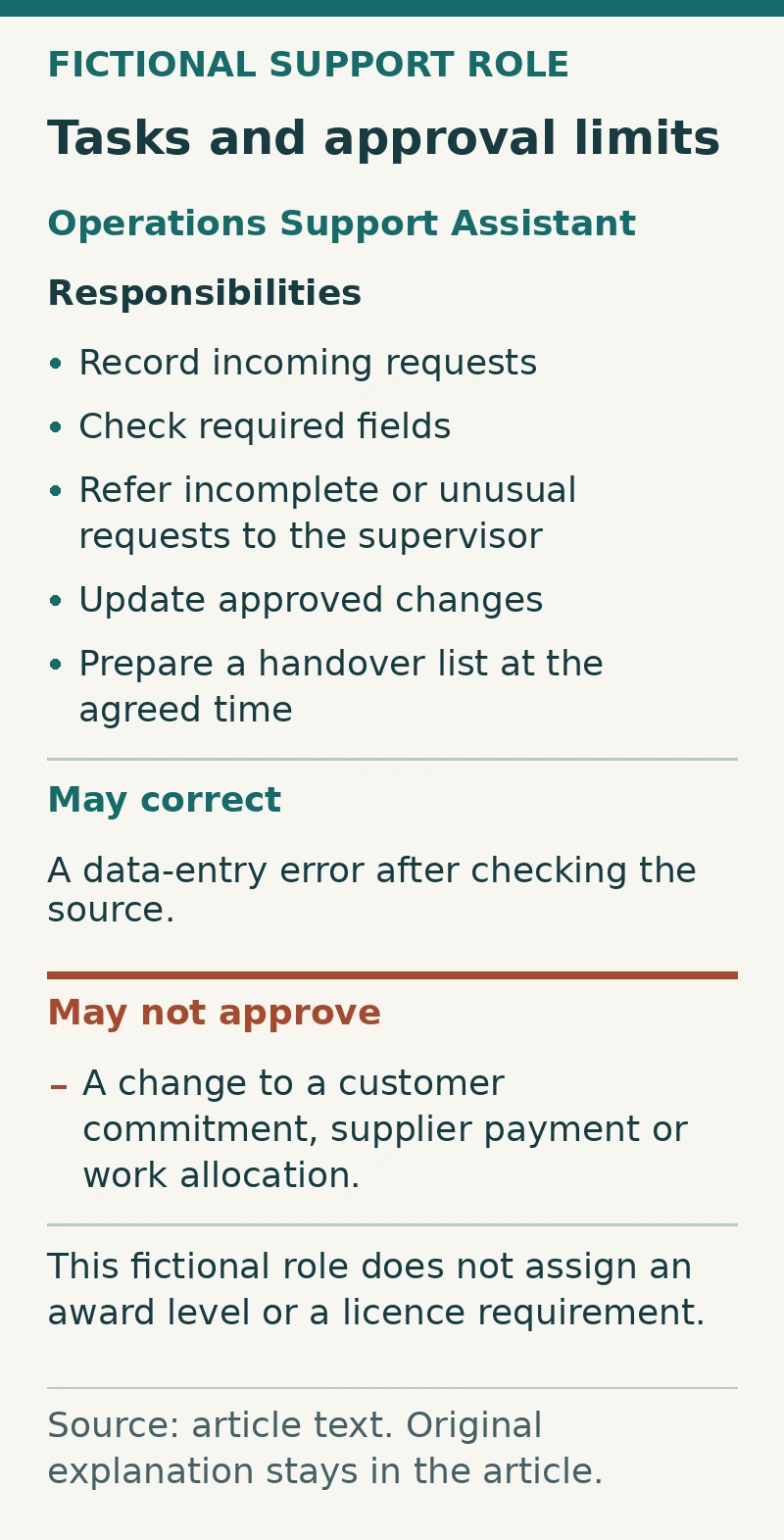
Responsibilities: Record incoming requests; check required fields; refer incomplete or unusual requests to the supervisor; update approved changes; and prepare a handover list at the agreed time.
Authority: The assistant may correct a data-entry error after checking the source. They may not approve a change to a customer commitment, supplier payment or work allocation.
Evidence sought: An example of maintaining accurate records, explaining a process clearly and recognising when a question needs escalation.
This fictional extract defines a support role without assigning an award level, inventing a licence requirement or implying that the employee manages the whole operation. It also gives interviewers something concrete to assess.
Separate capability from assumptions
Review each requirement against an actual duty. Do you need a particular qualification, or evidence that a person can complete the task? Is a driver’s licence genuinely necessary, or is the requirement reliable attendance at one workplace?
Describe essential duties accurately and discuss how they can be performed, including appropriate adjustments. JobAccess employer guidance provides a starting point for recruitment access and job-related assessment. Obtain advice where the application of legal requirements is uncertain.
Agree ownership and review points
The description should have an owner who can answer questions and approve changes. Check that it aligns with the proposed employment conditions and the work the supervisor can actually support. A job description does not replace an employment contract, applicable award or agreement, or safety procedures.
After hiring, use it to explain priorities and identify training needs. If responsibilities expand substantially, review the description and any classification implications instead of adding duties informally without discussion.
Our business-opportunity guide covers broader planning. For the current vacancy submission route, see employer information. Keep the internal role definition separate from the shorter advertisement candidates see.