




Ask about credit transfer when you have formally completed relevant study, and ask about recognition of prior learning when existing skills and experience need assessment against course requirements. An RTO can explain which process applies to each part of the proposed training; the same person may have evidence relevant to both.
The purpose is to avoid repeating learning unnecessarily while preserving proper verification and assessment. Neither route should be treated as an automatic qualification or occupational licence.

Separate the two evidence questions
ASQA’s credit-transfer and RPL guidance explains that credit transfer uses formal evidence of completed study, such as a transcript, statement of attainment or relevant USI transcript. The RTO checks the applicable requirements and evidence.
RPL considers skills and knowledge gained through training, work or life experience against the course requirements. It can involve work evidence, discussion or further assessment, and may lead to full or partial recognition or additional training.
Do not assume a similar unit title proves equivalence, or that years in a role establish every assessed requirement. Ask the RTO to explain the decision and any remaining gap.
Build a practical evidence-routing list
For each relevant part of the proposed course, record:
- Requirement: the unit or component being discussed.
- Completed study: formal evidence you hold, including the actual code and issuer.
- Experience: relevant work or other learning that may need assessment.
- Proposed route: credit-transfer enquiry, RPL enquiry or clarification needed.
- Verification: what the RTO needs and how it will be provided appropriately.
- Outcome: decision, reason and any further training or assessment required.
- Record: written confirmation and the updated course or training plan.
This list helps prepare an enquiry. The RTO, not the learner’s spreadsheet, determines what recognition is granted.
A fictional mixed-evidence example
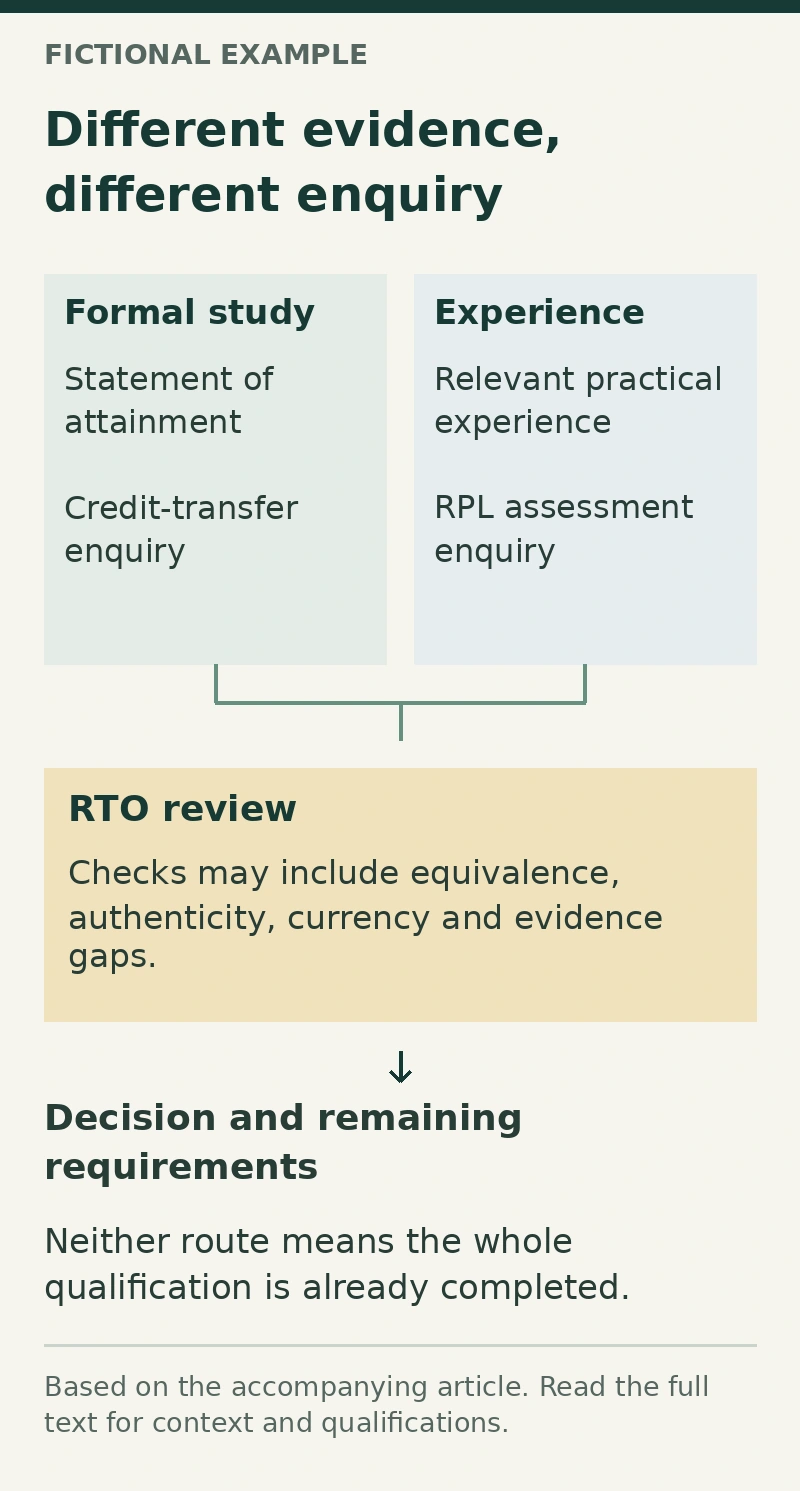
This original example is invented and uses no real unit code or recognition decision.
Alex has a formal statement of attainment for one completed unit and several years of practical experience relevant to another proposed unit. Alex gives the RTO the formal study evidence for a credit-transfer enquiry and asks about an RPL assessment for the experience-based component.
The RTO may need to check equivalence, authenticity, currency and evidence gaps through the appropriate processes. Alex does not combine both items into a claim that the whole qualification has already been completed.
The example demonstrates routing evidence to the right question rather than building a second RPL portfolio for material that may be handled through formal credit transfer.
Clarify costs and remaining commitments
Ask how an application, partial recognition or unsuccessful assessment affects fees, time and the remaining course requirements. Do not assume recognition eliminates every attendance, placement or other requirement without checking the actual plan.
Read the provider’s review or complaint process and retain the explanation if you disagree with a decision. Ask what additional evidence would address a stated gap instead of paying for an unsupported promise of an instant credential.
Update your records accurately
Keep the application, decision and revised learning plan together. Describe only the credential or recognition actually issued, with incomplete study or pending assessment clearly identified.
If a separate employer, professional regulator or migration authority needs evidence, check its requirements independently. A training decision resolves the RTO’s assessment or credit question; it does not automatically decide another organisation’s approval.
A recognition decision should still be checked against the qualifications required for your target role, rather than treated as approval by every employer or regulator.