

A reorder point is a stock level used to trigger a replenishment review under an agreed inventory method. A basic planning calculation combines expected demand during replenishment lead time with a defined allowance for uncertainty.
This guide uses invented ordinary-stock figures to explain the arithmetic. It is not a purchasing recommendation, demand forecast or method for safety-critical supplies.

Define demand, lead time and units
Use a consistent item and unit. Establish what the demand measure includes, the period used and how replenishment lead time is defined. A supplier’s dispatch estimate may differ from the time until usable stock reaches the workplace.
Business Queensland’s stock-control guidance discusses approaches to maintaining stock and reorder levels. Apply the business’s actual method and approved assumptions, particularly where demand or delivery times are variable.
Do not turn one unusually busy day into an average without investigating whether it represents the future work being planned.
A fictional calculation
Suppose an invented office uses six packs of stationery per working day. The illustrative replenishment lead time is four working days, and the business has separately chosen a fictional ten-pack safety-stock allowance for this exercise.
Expected lead-time demand is six multiplied by four, or twenty-four packs. Adding the ten-pack allowance gives an illustrative reorder point of thirty-four packs.
The arithmetic is 6 × 4 + 10 = 34. Every figure is fictional. The example does not establish how the safety allowance should be chosen for an actual item or how much the office should buy.
Check the inventory position before acting
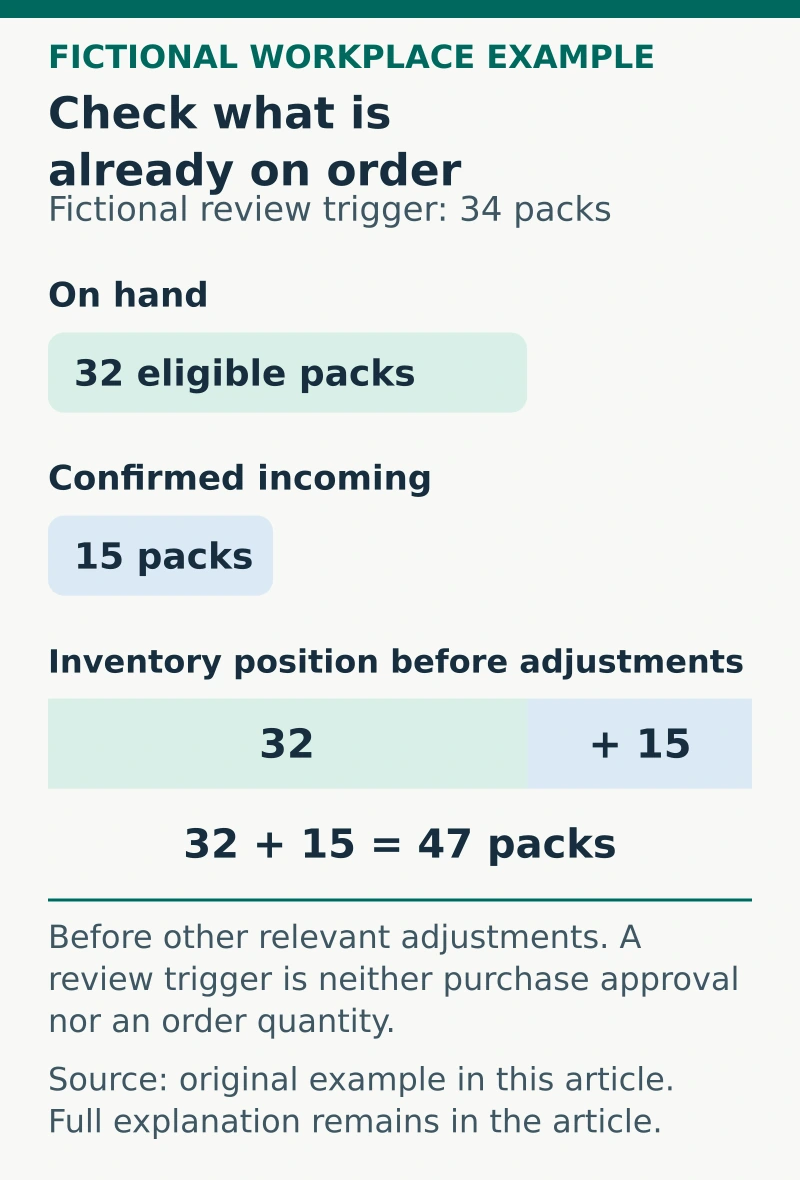
If the fictional office has thirty-two eligible packs on hand, no stock already on order and no outstanding demand adjustments, the simple position is below the thirty-four-pack trigger.
Now suppose fifteen packs are already on a confirmed replenishment order. That incoming stock changes the inventory position considered under the applicable method; thirty-two plus fifteen equals forty-seven packs before other relevant adjustments.
Check when the incoming order will become usable: stock arriving after an expected shortage does not solve that earlier gap. Ordering again without checking existing commitments could duplicate replenishment. The business should define how its method treats on-order quantities, backorders, allocations and stock that is unavailable for use.
Keep the trigger separate from the purchase decision
Use an original review record:
- Item and unit: the stock being planned.
- Demand basis: source period and relevant assumptions.
- Lead time: definition, evidence and uncertainty.
- Allowance: safety-stock basis and authorised review.
- Position: eligible stock, incoming commitments and relevant adjustments.
- Trigger: approved reorder level and current comparison.
- Decision: purchasing review, owner and approval still required.
A trigger does not automatically authorise a purchase order or determine order quantity. Check budget, terms, storage and the actual purchasing process separately.
Review assumptions as conditions change
Compare planned demand and lead time with actual records. Investigate repeated shortages or excess stock rather than repeatedly increasing a number without understanding the cause.
Update the method through the appropriate owner and preserve the basis of changes. A useful reorder point is an explainable planning control connected to accurate stock information, not a permanent number copied from an example.
To connect inventory planning with a career direction, explore logistics coordinator roles and check which stock decisions the actual job is authorised to make.