

A service level agreement should make the service, targets, measurement and responsibilities understandable. When reading one, identify what the provider is committing to do, when the clock runs and what happens if the target is missed.
This article uses a fictional internal service example. It is not a review of an actual contract or legal advice about enforcing terms.

Identify the service and its limits
Read the scope, covered users, service hours and exclusions. Check which requests are eligible and whether a separate priority definition applies.
Look for the relationship between the service agreement and other contractual or operational documents. A short target table may not contain every condition affecting the service.
The Queensland Transport and Main Roads project-management glossary provides broader context for documented project and service arrangements. The checking method below is original and should be adapted to the actual agreement.
Distinguish response from resolution
A response target concerns an initial action defined by the agreement. A resolution target concerns a different outcome. Acknowledging an enquiry does not necessarily mean the underlying problem has been fixed. When the agreement concerns technical support, our IT roles guide offers context for the work involved; use the actual agreement to establish who responds, who resolves the issue and when escalation is required.
Check how each target starts, pauses and ends. Terms such as “business hours”, “urgent” and “resolved” need a definition in the actual arrangement.
Where the wording is ambiguous, ask the responsible service or contract owner to clarify it. Do not create a local interpretation that contradicts the agreed terms.
A fictional timing example
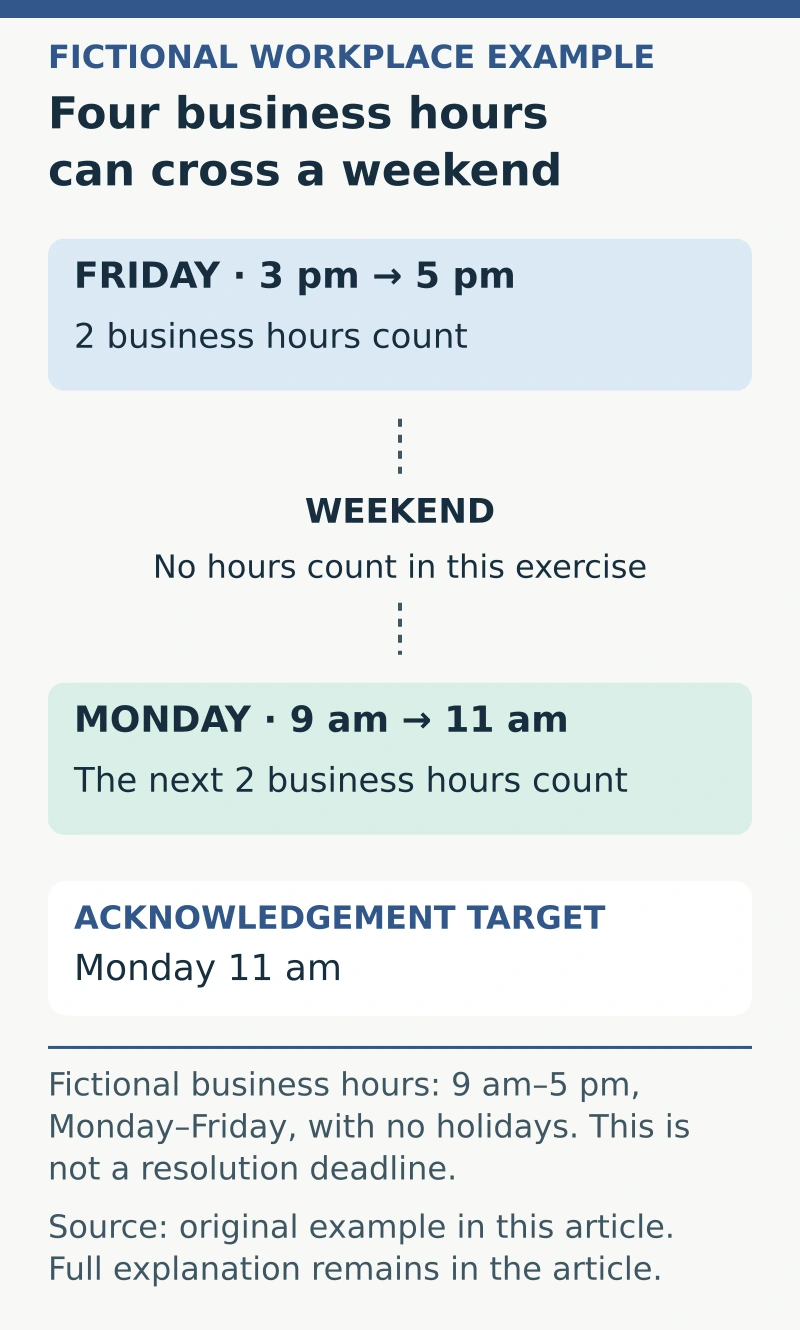
An invented office service promises acknowledgement within four business hours. For this exercise only, business hours are defined as 9 am to 5 pm, Monday to Friday, with no holidays affecting the example.
A request received at 3 pm on Friday has two business hours remaining that day. The next two business hours end at 11 am on Monday. Under these fictional definitions, the acknowledgement target falls then, not four calendar hours after receipt.
This example does not establish an actual provider’s hours or deadline. It illustrates why the clock definition matters, and it says nothing about when the request must be resolved.
Use a practical agreement-reading record
Capture:
- Service: covered work, users and exclusions.
- Target: response, restoration, resolution or another defined measure.
- Clock: start event, service hours and permitted pauses.
- Priority: criteria and person authorised to assign it.
- Evidence: system or record used to measure performance.
- Responsibilities: provider and customer actions needed.
- Escalation: route when a target or dependency is at risk.
- Review: reporting, changes and the relevant agreement owner.
Record questions as unresolved rather than filling gaps with assumptions. Identify any remedy or consequence only from the actual terms and appropriate advice.
Check performance using the agreed measure
Compare records with the defined target and note context, such as an incomplete request or an approved pause. Do not omit a missed target merely because the request was eventually completed.
Refer disputes or unclear terms through the proper process. A useful reading of an SLA produces a clear account of the service, measurement and next contact, allowing staff to explain what is promised without expanding it into an unsupported guarantee.