When comparing group training with direct employment, identify who employs and pays you, who hosts the work and how training and supervision are arranged. The qualification goal may be similar, but the organisations responsible for the employment and workplace experience can differ.
Compare the actual offer rather than assuming one arrangement always provides better pay, security or variety. Neither model guarantees a particular placement, completion date or future job.

Understand the group-training structure
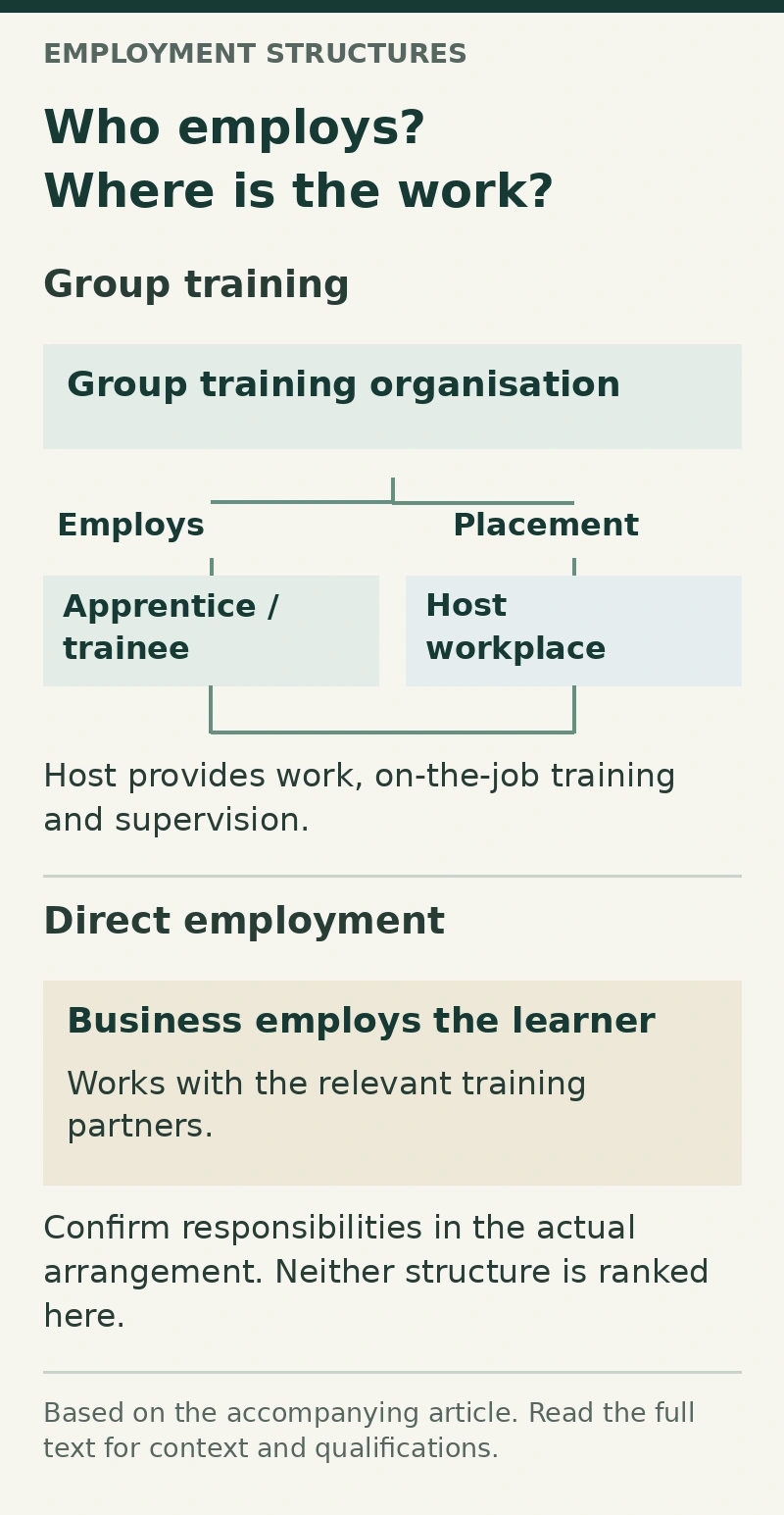
Business Queensland’s GTO guidance explains that a group training organisation employs apprentices or trainees and places them with host employers. A learner may remain with one host or rotate between hosts.
The GTO has employment and training-coordination responsibilities, while the host provides relevant work, on-the-job training, supervision and a safe workplace. Confirm how those responsibilities operate in the particular arrangement instead of assuming the host is the legal employer.
Under a direct-employment arrangement, the business employs the apprentice or trainee and works with the relevant training partners. The actual duties and training obligations still need to fit the recognised pathway.
Compare the same practical questions
Use this original decision worksheet for both options:
- Employment: legal employer, written terms and payroll contact.
- Workplace: initial location, host if relevant and travel expectations.
- Training: qualification, supervising RTO and training-plan arrangements.
- Supervision: who provides it and how required work experience is covered.
- Change: what happens if the workplace cannot provide a required task or placement changes.
- Costs: tools, travel, training and other questions under the applicable rules.
- Support: contact for employment, training, safety and personal-support enquiries.
- Records: who updates progress and how information moves between the parties.
Keep the answer to “who pays me?” separate from “who supervises today’s work?” Both matter, and they may name different organisations.
A fictional comparison example
This original example uses invented arrangements. Alex considers a direct apprenticeship with one business and a GTO offer involving an initial host placement.
Alex asks the direct employer how it will provide the range of work required by the training plan. Alex asks the GTO what placement changes could involve, how travel would be handled and who remains the employment contact during a move.
The decision is based on verified duties, supervision, terms and practical commitments. Alex does not assume the GTO offer is temporary employment merely because a host placement may change, or that staying with one employer automatically provides every required training opportunity.
Check conditions through the right source
Ask which award or agreement applies and how pay, paid training time, allowances and leave are determined. Do not borrow conditions from an unrelated apprentice or treat the model’s label as a pay rule.
Confirm the training contract and plan processes with the appropriate partners. Keep the employment offer, training documents and any host-placement information as related but separate records.
Make responsibilities easy to find
Before starting, prepare a small contact map for the employer, workplace supervisor, RTO and Apprentice Connect Australia Provider. Record which issue goes to which contact and how unresolved concerns are escalated.
Revisit that map if the host, supervisor or training arrangement changes. The useful comparison is not which model sounds more attractive; it is whether the actual arrangement clearly provides the work, training, support and conditions you need to understand before committing.
If your apprenticeship goal is a trade, compare the role requirements in our Brisbane trades jobs guide alongside the actual GTO or direct-employment offer.