Compare registered training organisations against the same learning and practical requirements: the training product, delivery and assessment, support, placement arrangements, total cost and enrolment terms. Check registration and relevant scope first, then decide whether the actual course arrangement fits your needs.
A provider being registered is important, but it does not mean every course it advertises suits every learner or occupation. Keep provider verification separate from choosing the best learning arrangement for your circumstances.

Set the course requirement before comparing providers
Write down the qualification, unit or skill set you are considering and why you need it. Confirm any employer or occupational requirement instead of choosing a course solely because its title sounds relevant. Our guide to job qualifications and requirements can help separate an employer’s stated requirement from a course that is merely advertised as useful before you compare providers.
ASQA’s course-and-provider guidance recommends considering goals, delivery, resources, support, placement arrangements and terms. Use the official national training register to check the issuing RTO and the training it is registered to provide.
Ask who issues the credential if the advertisement comes from a broker, agent or another business. A familiar marketing brand and the legal RTO identity may not be the same record.
Use a practical provider comparison
Compare each option using these fields:
- Training: exact product code, title and current status.
- Delivery: location, attendance, online requirements and practical components.
- Assessment: methods, expected evidence and further-assessment arrangements.
- Resources: equipment, software, materials and access the learner must supply.
- Support: learning, language, disability-access and technical assistance available.
- Placement: whether one is required, who arranges it, any learner costs and what happens if a suitable placement is unavailable.
- Cost: written total, additional charges and payment timing.
- Terms: cancellation, refunds, complaints and what happens if delivery changes.
Record the answer and its source, not just a tick. A vague assurance that “support is available” is less useful than knowing how to request it and what the provider actually offers.
A fictional decision example
The following original example uses invented providers and no real prices.
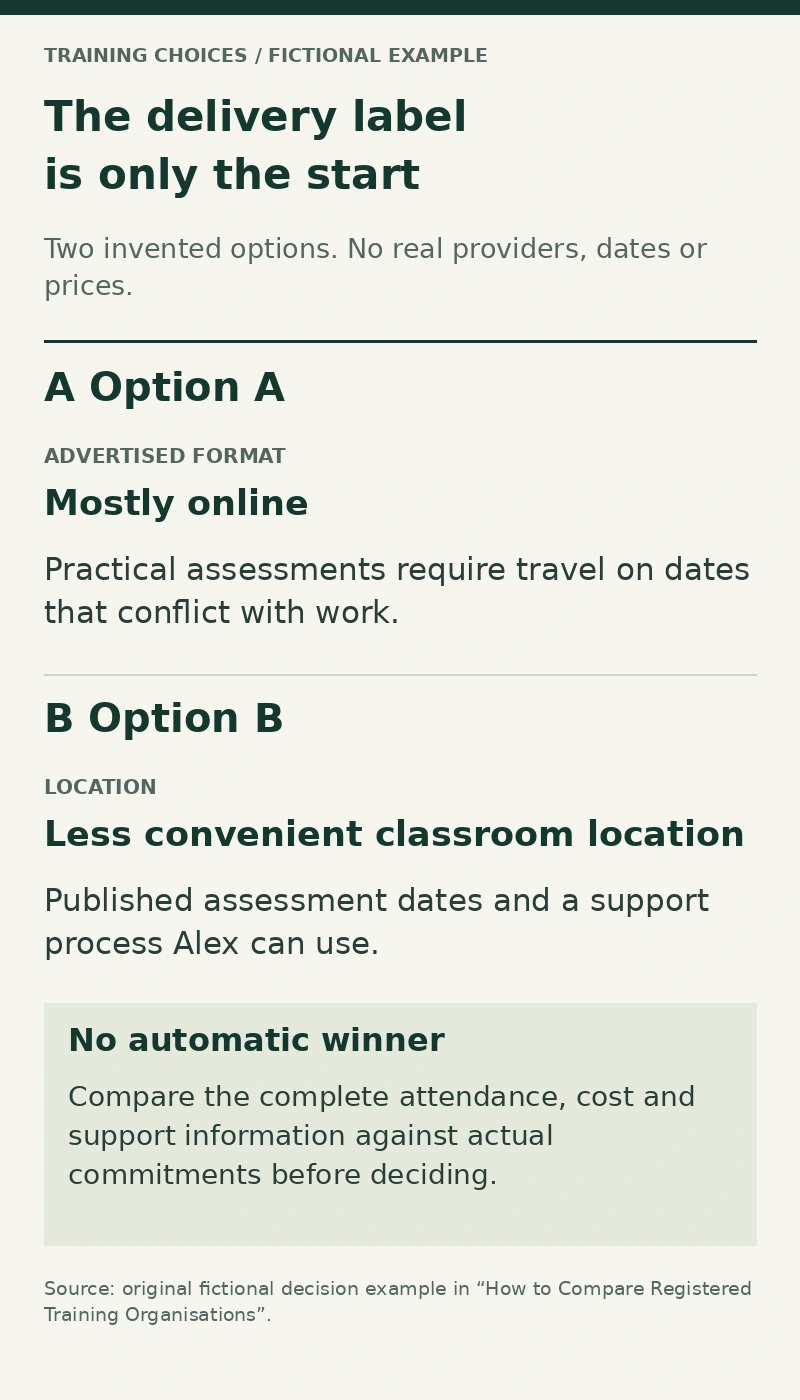
Option A appears convenient because it is advertised as mostly online. After asking, Alex learns that practical assessments require travel on dates that conflict with work. Option B has a less convenient classroom location but publishes assessment dates and a support process that Alex can use.
Alex does not automatically choose B. The next step is to compare the complete attendance, cost and support information against actual commitments. The example demonstrates why a delivery label alone does not establish fit.
Ask for the enrolment terms before paying
Read the proposed agreement and keep a copy of the information used to decide. Ask about unclear fees, course changes or placement obligations before making a commitment. Do not rely on an oral promise that contradicts the written terms.
ASQA’s student-rights guidance explains the importance of clear information and provider obligations. Check the actual terms and relevant assistance pathway if there is a dispute; ASQA does not resolve every individual fee or refund disagreement.
Choose with a traceable reason
Write a short decision note identifying the verified product, provider, practical fit and unresolved questions. Avoid relying on guaranteed-job claims or a promise that experience alone produces a qualification.
Retain the register check, written answers and enrolment documents privately. Recheck important details if the course, provider identity or proposed start changes before you enrol.