
Investigating a recurring work problem means checking what happened, testing possible explanations and identifying evidence that can distinguish them. Begin with a specific problem statement rather than a preferred cause or a person to blame.
This guide concerns an original low-risk administrative example. Formal incidents, safety matters, misconduct allegations or other regulated investigations need their appropriate processes and competent input.

Define the observed problem
State the affected work, relevant period and difference from the expected result. Use records to establish how often the event occurred and distinguish confirmed facts from reports still requiring verification.
The American Society for Quality’s root-cause analysis guidance discusses examining causes to support effective improvement. Asking why can be useful, but a chain of answers is not proof without supporting evidence.
Avoid a problem statement such as “staff do not care about accuracy”. It assigns a motive rather than describing an observable work gap.
Build a evidence-and-hypothesis record
Capture:
- Observation: the specific event or recurring gap.
- Expectation: the defined requirement and its source.
- Evidence: records, timing and accounts checked.
- Hypothesis: a possible explanation, clearly labelled.
- Test: information that would support or challenge it.
- Finding: what the evidence actually establishes.
- Action: proposed response and approval needed.
- Verification: how the result will be checked later.
Protect personal information and avoid circulating unverified allegations through a general improvement tracker.
A fictional recurring-report problem
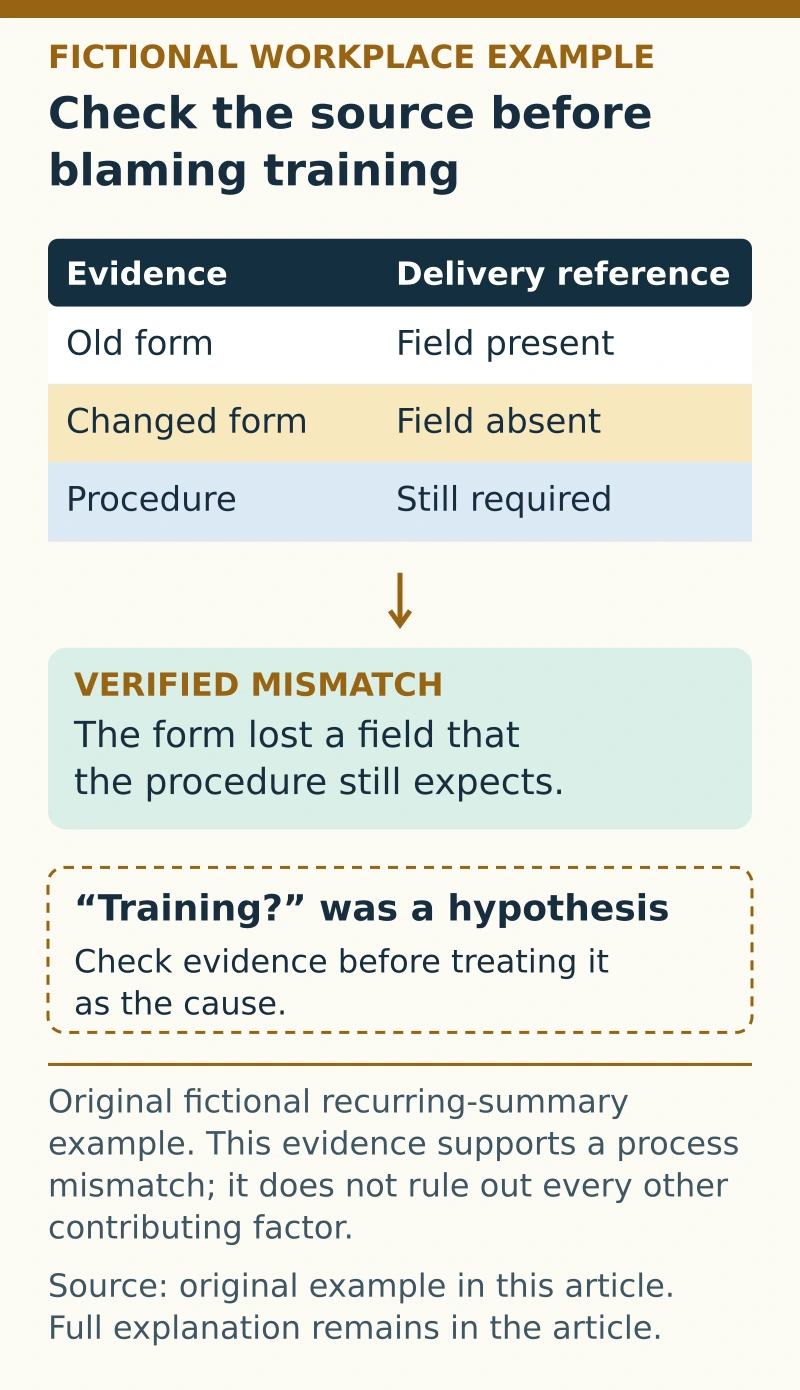
In this invented example, several weekly summaries omit a delivery reference. One hypothesis is that staff have not been trained. Another is that the new source form no longer displays the reference field.
The reviewer checks the procedure, training information, current form and affected examples. They find that the field disappeared when the form changed, while the written procedure still expects it.
That evidence supports a process mismatch. It does not prove training is perfect or rule out every other contributing factor, but it gives the team a specific cause to address and verify.
Test alternatives rather than collecting agreement
Ask what evidence would make the current explanation less likely. Check exceptions: when did the task work, and what was different then?
Use interviews or discussions to understand the work, not to obtain a confession supporting a manager’s theory. Record disagreement and uncertainty where they matter.
If the investigation needs technical or specialist judgment, refer that question to the appropriate person. An administrative review should not claim expertise it does not have.
Connect the finding to an authorised action
For the fictional form mismatch, the proposed action may involve restoring the required input and aligning the approved instructions. The responsible owner reviews and approves the actual change.
Then check whether later summaries contain the correct reference and whether another problem has been introduced. A requested change is not evidence that the cause has been removed.
Keep the finding, decision and follow-up traceable. A useful investigation produces an explanation supported by evidence and an action capable of being tested, while retaining enough context to revisit the conclusion if new information appears.
To use problem-solving evidence in an application, describe your own investigation and verified contribution. The career development guide can help you plan which skills to build next.